The Battle of Carfax in its wider context

It was a great honour to present, along with my old comrade Shan Sriharan, a speech to mark the 90th Anniversary of the Battle of Carfax at the Florence Park Community Centre yesterday evening (the 25th November). We were very proud to share the stage with respected writer and activist, David Rosenberg, who spoke with great insight on the Battle of Cable Street (also celebrating its 90th anniversary). 

It was fitting that the talk was in Florence Park, as this area, still known locally to older residents as Little Wales, was home to a community of former coalminers and their families who had walked and cycled from the Rhondda Valley in the 1920s and 30s to find work at the then booming Cowley Car Plant. 

A number of these men and women were at the forefront of the fight for union recognition at Cowley which culminated in the famous strike of 1934. These same workers played a crucial role in the anti-fascist activities covered in the speech.  

Research for the talk uncovered some interesting information that had to be left out to meet time restrictions, so over the coming months, I hope to explore a number of individual threads of the story in more detail – possibly in a series of mini articles.

In the meantime, while we’re still in the 90th anniversary year, here’s the transcript of the speech:


The Battle of Carfax

‘And so, I established in 1919 a program and tendency that was a conscious slap in the face of the democratic-pacifist world (…) [We knew] it might take five or ten or twenty years, yet gradually an authoritarian state arose within the democratic state, and a nucleus of fanatical devotion and ruthless determination formed in a wretched world that lacked basic convictions.

Only one danger could have jeopardized this development – if our adversaries had understood its principle, established a clear understanding of our ideas, and not offered any resistance. Or, alternatively, if they had from the first day annihilated with the utmost brutality the nucleus of our new movement.

Neither was done. The times were such that our adversaries were no longer capable of accomplishing our annihilation, nor did they have the nerve. Arguably, they furthermore lacked the understanding to assume a wholly appropriate attitude. Instead, they began to tyrannize our young movement by bourgeois means, and, by doing so, they assisted the process of natural selection in a very fortunate manner. From there on, it was only a question of time until the leadership of the nation would fall to our hardened human material’.

Adolf Hitler at the 1933 Nuremberg Nazi Party rally

‘If the enemy had known how weak we were, it would probably have reduced us to jelly. It would have crushed in blood the very beginning of our work’.

Joseph Goebbels, Nazi Minister for Propaganda 1934

On 27th March 1933, the British Union of Fascists headquarters on Walworth Road, Elephant & Castle, was attacked by a group of 300 communists, many armed with iron bars. Rooms were wrecked and the wooden bannister leading up to the fascists’ offices was destroyed as the communists smashed their way upstairs. Fierce fighting continued until police arrived on the scene.

The attack, at 11 am, was the second of the day with the fascists said to be “living in a state of siege” after a smaller attack in the early hours of the morning. The fascists were soon asked to vacate their headquarters by the building’s landlord.

The South London Press, 28th March 1933

The standard liberal/left narrative regarding the fight against fascism in Britain in the 1930s, is that violent opposition to the British Union of Fascists was hesitant, minimal and spontaneous; driven, when it did surface, by outrage at the brutality of Oswald Mosley’s, Blackshirted, Fascist Defence Force. 

At least part of the reason for the perpetuation of this fallacy is to give the illusion of an equivalence between 1930s working class led, militant anti-fascism and today’s predominantly middle class, passive, tendency. 

Liberals often cite Mosley’s 1934 London Olympia Rally and the 1936 Battle of Cable Street when referencing the period; the former as a cautionary tale about the futility of taking bully boys on at their own game and the latter as a comforting fable of the inevitability of the triumph of good over evil – eschewing community camaraderie and individual responsibility.

A close evaluation of these and other events of the period, quickly dispel these illusions and 1930s militant anti-fascism is shown to have been highly organised and operating at consistently high stakes levels. It was also extremely efficient and at times, absolutely ruthless.

Needless to say, anti-fascism of the 1930s is at complete odds in quantity and quality with today’s variant, and we need to recognise this or face the same consequences that our European comrades did in the 1930s and 40s.

The violent attacks on 7th June 1934, on anti-fascist protesters at West London’s Olympia Exhibition Hall, by Blackshirt stewards were broadcast across the media for the world to see. This caused wide-ranging outrage and concern, forcing a number of wealthy dilettantes (including Daily Mail owner Lord Rothermere who had praised Mosley, Mussolini and Hitler in his paper) to distance themselves from the BUF. 

The violence of the Blackshirts was indeed shocking and the public concern very much warranted, but in rank and file recruitment terms, it did the BUF little harm. Mosley had previously declared that one of his first acts, given power, would be to ‘suppress the Communist movement’ and taken at face value, Olympia indicated that he was already capable of doing so. But in reality the Communists and wider anti-fascist movement had a lot more to offer.

According to the accounts of Jewish, East End, communist organisers, Joe Jacobs and Phil Piratin – accounts echoed in Special Branch reports – tooled up anti-fascists attacked the Olympia meeting with the intention of causing as much damage as possible to the physical well-being of the attendant Blackshirts and to Mosley’s growing populist reputation. 

While the overwhelming odds against them prevented militants from their objective of stopping the rally, the violence was not all one-sided, as squads of anti-fascists patrolled the streets around Olympia after the rally, picking off bite-sized groups of BUF members making their way home.

A similar story was played out at Cable Street (though this time, of course, the odds were overwhelmingly in favour of anti-fascism). The Battle of Cable Street does tick many of the boxes for a liberal left fantasy of the effectiveness of non-violent resistance to fascism, but the truth of the matter is that the Police stopped Mosley from marching through the East End (and believe me, he was happy to oblige) because his safety could not be guaranteed. Angry locals, including a hard core element of Jewish and Irish communists, were primed and ready to go (communist organization was ‘unequalled’, and military in its execution according to Piratin) and where they were not engaged in hand to hand fighting with the police, militants again, knocked the living daylights out of Blackshirts as they headed home.

Sanitised versions of these two famous episodes, and other such events, rewritten to suit the current liberal/left dispensation, are both disingenuous and dangerous – primarily because peddling of false narratives prevents us from learning lessons from the past.

The idea that it took BUF violence at the Olympia rally to spur militant anti-fascists into action is a myth. I hope to help dispel this and put the Battle of Carfax (and other events from this period) in a more logical and useful context. 

BUF meetings and rallies had been subjected to persistent attacks from anti-fascists for well over a year before Olympia. 

 In March and September 1933 for instance, there was violent opposition to Fascist meetings in Manchester and Stockton. At Stockton, fascists were attacked with staves, sticks and pick axe handles and bombarded with bricks and potatoes studded with razor blades. 

On November 3rd 1933, Mosley held his first public meeting in Oxford, at the Carfax Assembly Rooms where violence broke out between anti-fascists and around 150 members of the Fascist Defence Force, drawn mainly from the Oxford University Fascist Association. 

Oxford’s organised working class was still relatively small at the time, but a tough left wing contingent had united under the banner of the Oxford Council of Action Against War and Fascism. Key players in this new alliance were activists from the National Union of Railwaymen, the Amalgamated Engineering Union, bus drivers from the Transport and General Workers’ Union and the Red Shirts – a working class anti-fascist squad from Ruskin College. These activists disrupted the meeting through heckling and physical confrontations, bringing proceedings to a chaotic conclusion.

Fascists returned to Oxford in April 1934, attacking a meeting of the National Unemployed Workers’ Movement that was being addressed by veteran Dockers’ leader, Tom Mann. 

The NUWM was spearheaded by industrial militants who had been the first ones out of the door and the last ones to be rehired by vengeful employers during the post First World War slump, the General Strike and the Great Depression. The organisation rejected begging bowl politics in favour of high profile, organized mass protests, direct action and hunger marches to draw attention to the plight of the jobless.

Anticipating the appearance of the BUF, Oxford Council of Action Against War and Fascism was on hand to protect the meeting and the fascists were dispatched without ceremony.

Away from Oxford, police baton charges were used in Plymouth and Newcastle in April 1934 where serious injuries were recorded. In Gateshead, Blackshirts who attacked a Mayday parade were forced into a bloody, humiliating retreat by local activists. 

Back in Newcastle a month later, the BUF came up against: ‘Highly organized, aggressive anti-fascist disruption tactics’. 

Again in Gateshead a day later, Blackshirts armed with knuckle dusters and heavy rubber tubing provoked fierce fighting with anti-fascists, but were overwhelmed by around 10,000 counter demonstrators. 

So evidently, the violence at the Olympia Rally the following day, would have been no surprise to anyone who had been paying attention.

Mosley was not going to allow the controversy around Olympia to stall his movement’s momentum. On the contrary, he hoped to capitalise on the boost to his reputation as a tough man of action and across the weekend of June 9th and 10th 1934, the BUF held a string of concurrent outdoor rallies across North and East London – including Finsbury Park, Hackney, and Regent’s Park. Anti-fascists successfully disrupted most of these gatherings. 

Needless to say, left wing attacks against the BUF only intensified between Olympia and the Battle of Cable Street and by 1936 around 60% of BUF meetings faced organised, physical, resistance. 

Ten days after Olympia, Oxford based Communist organiser, Abe Lazarus, helped organise an anti-fascist rally in Hyde Park. A testament to the meticulous planning of this event and the physical presence of militant anti-fascists can be seen in Parliamentary questions and police reports that state there was ‘no disorder at any time and no arrests made’. 

In June 1934 the Home Secretary was asked in Parliament to make a statement ‘regarding a fascist meeting held in Bootle, Liverpool on the 18th (of that month) where a woman was found dead on the ground, and where there was grave disorder and damage’. A crowd of around 500 protesters, mostly women and children, had chased a van full of fascists back to their HQ, smashing all the vehicle’s windows in retaliation for an assault on a black child by a BUF steward. The woman in question had dropped dead of a heart attack amidst the chaos.

In September 1934 another BUF rally at Hyde Park was swamped by a massive counter-demonstration and in October there was more street fighting in Worthing, when Mosley attempted to hold a meeting.

In February and April 35, seemingly concluding that outdoor rallies were more trouble than they were worth, Mosley held well attended indoor meetings at Middlesbrough and Leicester, but again, Communist militants heavily disrupted proceedings.

The Leicester meeting was significant as this was where Mosley shifted the BUF’s focus towards aggressive antisemitism. Hitler, accordingly, sent a telegram of approval.

By now it was becoming increasingly difficult for the BUF to persuade local councils to accommodate them, given the reputation for violence at their meetings. Nevertheless the circus continued. 

On 8 March 36, Mosley proclaimed his support for Nazi Germany at a rally in Nottingham. The Daily Worker reported that: “When the Blackshirts attempted to remove one heckler, a general uprising took place, and the whole of the back of the hall became one grand free fight in which some 20 rows of chairs were overturned, after which a general exodus took place. The BUF newspaper reported that the windows of the local fascist bookshop were also smashed in.

In Barnsley, later that month, a number of coalminers were arrested at a BUF meeting for breach of the peace and rocks were thrown at departing Blackshirts as Mosley snuck out the back door. George Orwell, an observer at the meeting, noted that ‘Mosley kept extolling Italy and Germany but when questioned about concentration camps etc, replied:

‘We have no foreign models; what happens in Germany need not happen here’.

On 22nd March, Anti-fascists faced a police exclusion zone that parked them half a mile away from a major Mosley meeting at the Royal Albert Hall. The National Council for Civil Liberties called for an inquiry over the use of mounted police baton charges against the protesters.

Precisely a week before Oxford’s Battle of Carfax, there was a second meeting at Leicester’s Granby Hall which was even more chaotic than the first one. The Leicester Mercury reported that: ‘The evening began with a drum roll as Mosley took to the stage, but soon segued into the familiar sound of bawling and brawling’.

Which brings us to Oxford, and The Battle of Carfax.

But first, a bit of global context:

The Fascists, by now, had control of Italy, Germany, Spain, Portugal and Japan, had become a serious force in Ireland and were gaining influence in many other countries.

In Italy, Mussolini’s flagship fascist regime had been in power since 1922 and had systematically destroyed the once powerful organised working class with paramilitary terror and state legislation. In the process, squads of Fascisti had tortured and assassinated left wing opponents and looted and burned down Communist, Socialist and Anarchist union halls, community buildings and printing presses. 

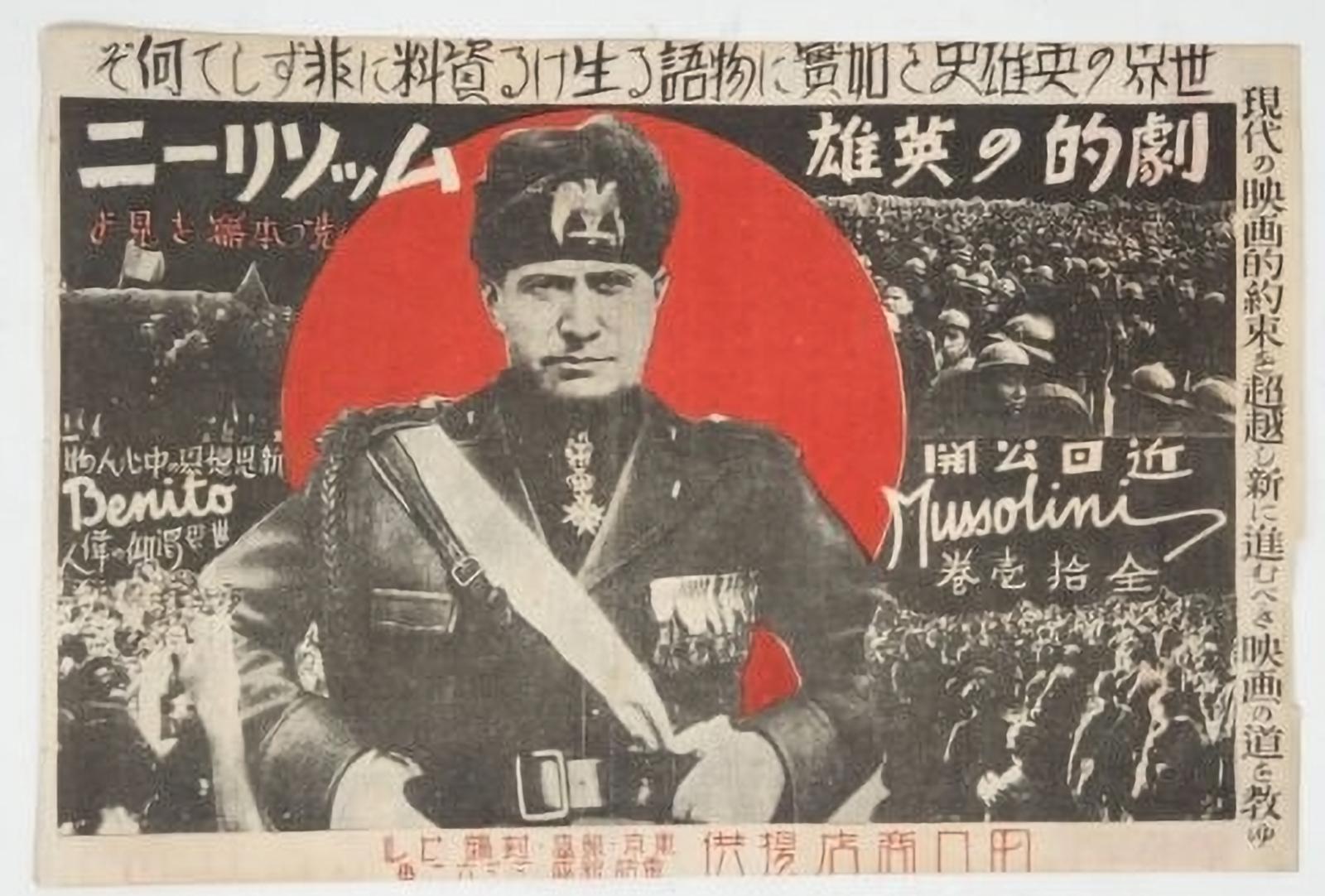
In Japan, where Mussolini was idolised, the fascist government had criminalised socialism, communism and trade unionism in 1925, and was now turning its attention outwards, unleashing hell in China and Korea.

In Germany the Nazi’s had crushed the largest working class movement in the world (outside of Russia) and communists and socialists who hadn’t already been tortured and executed, had been interned in Dachau Concentration Camp which had by now, been operating continuously for two years. 

Over on the Iberian Peninsula, Salazar’s three year old Portuguese fascist state which had initially exiled left wing opponents to Madeira island, had now established torture chambers and concentration camps in Lisbon and Cape Verde. Across the border in Spain, Franco’s fascist forces were planning a military coup which would plunge the country into bloody civil war – the result of which would go some way to determine the success of fascism globally and was to preoccupy the European left for the following half a decade. 

Across the water in Ireland, the rapid growth of fascism was also of grave concern to the British left. The Army Comrades Association (or Blue Shirts), which restricted its membership to National Army (Pro-Treaty) veterans, a number of whom had committed atrocities in the Civil War, was the largest non-governing fascist organisation in the world. Blue shirts had earned a reputation for political terror and murder having carried out heavily armed attacks on both left wing republicans and the recently formed Garda Siochána – the state’s unarmed police force. 

Pound for pound, the Blueshirts dwarfed the BUF. The BUF had 40,000 members in a British population of 50 million without a single elected MP. The Blueshirts had 47,000 members in a population of just over 3 million. The Irish fascists had 60 representatives in Dáil Éireann (the Irish Parliament) and posed a serious threat to nascent Irish democracy. 

Reports of the growing fascist menace from the continent and Ireland were the topic of mainstream newspaper articles, and of course, the left wing press – in particular the widely read Daily Worker – which provided informative comment and analysis on the subject. 

The potential of Mosley to establish fascism in Britain hadn’t escaped the attention of his continental counterparts either, with Mussolini and Hitler having donated the equivalent of £19 million to his fighting fund. 

So, Leftists organising the welcome party for Mosley in Oxford, were well aware of the scale of the looming international threat from fascism. 

Mosley faced significantly stronger opposition when he held his second public meeting in Oxford on the 25th May 1936.

This was because Oxford’s working class had itself become stronger, through a series of successful strikes. The most important of these was for union recognition at Pressed Steel, which supplied car bodies for William Morris’ Morris Motors. 

The car magnate was viciously anti-union, anti-socialist and anti-Semitic and was a major financial backer of Mosley, first funding his proto-fascist, New Party, to the tune of £4.5 million in today’s money, and then supplying a further £3 Million to support the BUF newspaper, Action. 

The Communist Party’s support for the Pressed Steel strike helped Cowley become its largest industrial branch in the country. Included amongst the militants were a number of highly politicised, battle hardened men and women from the coalfields of South Wales who had forged a strong community around the Florence Park estate, or Little Wales as it became known locally.

But the car plant wasn’t alone in its industrial militancy; at the time of the Battle of Carfax, local Busmen were engaged in an ongoing national strike. Busmen were known for their toughness (in the days before power steering and air brakes, bus driving was a very physical occupation) and the nature of the job meant that drivers enjoyed a high profile within the local community. They also had the advantage of an intimate knowledge of the layout of the assembly rooms, as it was the venue of ongoing strike meetings. 

Given traditional Town & Gown hostilities and the university’s role in breaking the General Strike a decade earlier – especially the use of students to drive public transport – there is little doubt that Busmen relished the thought of getting stuck into Mosley’s undergraduate supporters. 

On the night, the assembly rooms were decked with Union flags in preparation for Mosley, who, flanked by his black-shirted bodyguards, stepped onto the platform to the strains of the Nazi Anthem ‘The Horst Wessel Song’. 

The first five rows of the BUF meeting were filled with Mosley supporters from the local gentry, including University Chancellors, Tory councillors and at least one magistrate. The meeting was over a thousand strong (although only around a quarter supported the BUF). Most of the anti-fascists present were Cowley car workers, busmen, railway workers and other trade unionists, including a block from Ruskin College. A hardcore communist thread ran through most of these groups.

The level of vitriol in Oxford seemed to catch Mosley off guard. At one point in the meeting he lashed out at the loudest group of hecklers:

‘I know you Ruskin fellows with your stage guardsmen accents’ (a reference to the fact that Ruskin students were drawn mainly from the industrial working class).

Shortly afterwards BUF stewards turned on Basil Murray, a left wing University student who was a passionate supporter of the anti-fascist cause in Spain. In defiance of Mosley’s warnings to shut up, Murray repeatedly exclaimed: ‘Red Front!’ – a reference to the revolutionary left wing alliance in Spain.

Given Mosley’s well known tactic of sending stewards into the audience to silence dissent, Murray’s outburst was probably designed to draw Blackshirts off the stage, to within swinging distance of anti-fascist militants, and it wasn’t long before all hell broke loose with the anti-fascists soon getting the upper hand – the favoured weapons being fists and metal chairs. 

Elizabeth Longford, whose husband was involved in the disturbances recalled that:

‘Mosley gave a sign to the posse and Blackshirts moved forward and seized Basil. The bus drivers picked up the chairs and bashed the posse over the head with them. You couldn’t see across the hall as it was swirling with dust’

When the dust had settled, four fascist were taken to the Radcliffe Infirmary with serious head injuries, while many more went home battered and bruised. Mosley, true to form, took the opportunity afforded by the mayhem to sneak out the back door, only to find that the cars and coaches that had transported the BUF to Oxford had received the attention of anti-fascist mechanics.

Afterwards hundreds of left wingers spilled out onto the streets, – many singing the Internationale, to celebrate their victory. 

Academic Stephen Cullen describes the Battle of Carfax as: ‘Something of a propaganda coup for the anti-fascists, showing how they were capable of fully exploiting, to their advantage, violent situations for which they were primarily responsible. He asserts that preparations by communists and other anti-fascists before the Carfax meeting were thorough. And that various meetings were held to rally anti-fascist support.

One such meeting was organized by the Communist Party at St Giles on 17th May. A police report comments: “This meeting was addressed amongst others by Donovan Brown ‘a noted communist’, who urged all workers and communists to … keep Mosley out … (and, if not) to give him such a time that he would not forget it for the rest of his life. 

A further meeting was held the following Sunday, at which ‘Abraham Lazarus, a noted communist … who is known as Firestone’, enlivened proceedings by literally frothing at the mouth during his speech calling on people ‘to prevent Mosley speaking’.

The acknowledgement that violent confrontation with the BUF was likely to be an obligation for anti-fascists, was locked in from day one. At the founding meeting of the Oxford Council of Action against War and Fascism in the Spring of 1933, it was agreed that protestors would wear red as a symbol of membership so that: ‘In case of rough and tumble’ militants didn’t ‘bash the chap on their own side.’ 

Inadvertently, it is also within the fascists own, contemporary accounts that a glimpse of the true turn of events reveals itself. Outraged at the belligerence of working class militants who had the sheer audacity to challenge ‘Sir Oswald’ – ‘in Oxford of all places!’ – A BUF steward felt compelled to pen a letter to the Oxford Times. His comments reinforce the picture of a well organised, imposing anti-fascist presence:

I should be grateful if as a supporter of Sir Oswald Mosley and consequently steward at his meeting on Monday night I might be granted space to reply to Mr Gordon Walker‘s letter in your issue of yesterday. 

Before the meeting commenced it was apparent to me from watching the arrival of several well-known communists together with their supporters that they had not come with any intention of listening to the fascist case, but of putting into practice their often repeated slogan: ‘Smash Mosley!’. 

In the hall I undertook steward duties by the platform and had an un-obstructed view of the events which led to the first ejection of an interrupter. To say nothing of the yells and cat calls which were repeated at intervals before the meeting, I was amazed to see Mr Gordon Walker when Sir Oswald Mosley started his speech, spread out a newspaper and flaunted it. In the opinion of many people present Mosley received their torrents and insults with remarkable patience and good humour. It was this that caused the interruptions to be so incessant that one particular individual who was persistently troublesome had to be ejected after repeated warnings from the speaker.

I state here, quite definitely, that it was because members of the audience interfered with the stewards that any single person was hurt and I am convinced that many innocent people would have been injured but for the organised resistance of our stewards against the hooligans.

P J Cox, YMCA Oxford

Mosley later complained after the meeting, of: ‘the worst scenes of hooliganism I have experienced during the hundreds of meetings I have addressed up and down the country’.

The jury is still out on the precise details of what actually happened in the Assembly Rooms on the 25th May 1936. There are a number of witness statements from those who were, at the time, left wing University students, but of these, most were written well after the event by people who, by that time, had ‘respectable’ reputations to protect. Some statements are conflicting, such as that of Frank Pakenham, later Lord Longford (husband of Elizabeth) who, having joined the establishment he once railed against, was keen to play down his activities in 1936. Pakenham appears to have lost the plot on the day, lashing out uncontrollably at fascist stewards when he was blindsided by a rabbit punch, but his own account acquits him of even raising a hand in self defence! 

There are no statements from working class combatants. This is unsurprising as a confession of conspiracy to commit political violence would not have been a wise move given the ominous political situation at home and abroad. Basil Murray was prosecuted for breach of the peace for passive resistance in the face of fascist brutality, so it’s certain that working class communists would have fared a lot worse, potentially losing their liberty and livelihood and leaving their families to pay the price. 

So in lieu of first hand accounts of those who executed the attacks on the BUF at Carfax, we are left to extrapolate from other sources, including the knowledge of the mechanisms of organised anti-fascist resistance across Britain and Ireland at the time. A campaign, of course, that was coordinated by the Communist Party, of which key players in Oxford were staunch, card carrying members.

The evidence then suggests, that the working class, anti-fascist militants of the 1930s, such as those responsible for the assault on Mosley’s Blackshirts at the Carfax Assembly Rooms, had understood the principle of fascism, established a clear understanding of its ideas, and resolved to do whatever needed to be done to stop it taking root on British soil. History shows that their mission was ultimately successful, and for this, we should all be eternally grateful.
The Battle of Carfax

May 25th 2026 marks the 90th anniversary of the ‘Battle of Carfax’, a relatively small scale, but nonetheless significant defeat for Oswald Mosley’s British Union of Fascists at the Carfax Assembly Rooms, Oxford City Centre. 

At the time of the incident, fascism was on the ascent across Europe and Mosley, a high flying, well connected, aristocrat, fancied himself as the British Hitler. The success of the physical resistance to the BUF in Oxford in 1936, should be understood in the context of the international struggle against fascism being waged by the organised working class at the time. 

The attack on the BUF was no isolated event. The party had faced violent opposition in major cities across Britain over the same period and just six months after the confrontation in Oxford, came the pivotal, Battle of Cable Street in London’s East End, which put a major dent in Mosley’s ambitions, before his imprisonment at the outbreak of WW2 as an enemy of the state, removed him permanently as a serious political contender. 

Locally, the ‘Battle of Carfax’ marked a pattern of resistance that has echoed across the subsequent decades, yet liberal accounts of the affair, both contemporary and historical, tend to obscure the level of violence from the anti-fascist side (or at least to seek to justify it only on the grounds of fascist provocation). This is a dangerous, wilful misinterpretation of history. 

While it’s true that on one level, anti-fascist violence was, and is, self defence (by virtue of fascism being essentially committed to the destruction of the organised working class), the attack on the BUF in 1936 was in the main, organised, pre-emptive, self-defence. 

By recognising the nature of the beast, working class militants at Carfax in 1936, understood what needed to be done, and had no hesitation in beating the fascists at their own game.  That said, as a senior member of Anti-Fascist Action once put it: ‘Violence is a tactic, not a principle’, and in fact violence alone is not sufficient for the long-term combatting of fascism. There are certainly times when violence is absolutely necessary, but primarily as a means to provide a space for fascism to be defeated in the political arena.

In Britain in the 1930s, fascists first attempted to control the streets in the hope of emulating their European counterparts in Italy and Germany. Over here, they were unsuccessful, but across Europe, as we all know, a different story unfolded and the world went to war as a consequence. 

When the dust finally settled after World War Two, fascists again slowly began to resurface, and with varying degrees of success, attempted to regroup by once again fighting to control the streets. Thankfully, each generation has spawned working class militants willing to physically oppose them, and as a result, the far right was forced, in the mid 1990s, to eschew street confrontation as the primary vehicle to power. This in turn convinced serious activists that, for the time being at least, physical confrontation from anti-fascists would be counterproductive and as long as fascists continue to pursue the Euro Nationalist ‘suit and tie’ electoral route, this principle still stands. 

Last week saw a perfect example of how fascism can be defeated (in the short term at least) through non-violent means. In Portugal, the far right party, Chega, was defeated in the presidential elections. Chega are part of the international fascist renaissance. They fancied their chances to at least, (through a close result), set their ducks in a row for their candidate and party founder, André Ventura, to become Prime Minister of Portugal at the next General Election. Thankfully, a united front of left parties closed ranks against Chega and tapped into the justifiable national fear of a return to the bad old days of fascist dictatorship and Ventura was resoundingly defeated by António José Seguro of the centre left Socialist Party. 

Before we break out the champagne though, it is important to understand that, as the presidential role is largely a ceremonial one and as the current centre right PSD government has made no commitment to tackling the housing crisis, (the main issue being racialised and exploited by Chega) we are not out of the woods yet. On assuming his role as the new President, António José Seguro stated that there is much work to be done. This, we can probably all agree on. 

Interestingly, the previous Portuguese dictatorship of António de Oliveira Salazar  – the longest running fascist regime in the world – was toppled by an almost bloodless revolution when the left wing, Movimento das Forças Armadas (Armed Forces Movement)  instigated the ‘Carnation Revolution’ of April 25th 1974. Proof, if it were needed, that relatively peaceful resistance to fascism is actually possible – so long as you have control of the state military! 

I wrote the following article, which covers much of the history of fascism and anti-fascism in Oxford – including an account of the attack on the BUF at Carfax in 1936 – in 1997 for the Anti-Fascist Action publication: ‘Fighting Talk’. 

In 2002 I was elected City Councillor for the Northfield Brook/ Blackbird Leys ward representing the Independent Working Class Association. The IWCA was an Anti-Fascist Action initiative aimed at filling the political vacuum created by the abandonment of the working class by New Labour – a vacuum that was then being filled in a number of areas, by the most successful fascist party at the time, the now practically defunct, BNP. 

Given the current global resurgence of ultra conservative politics, and locally, recent tentative attempts by outside agitators to establish a foothold for reactionary politics in Oxford, I believe that it is well worth reacquainting ourselves with the proud tradition of working class resistance to fascism in our city. 

Brief Encounters:

A History of Anti-Fascism in Oxford

Oxford cannot claim to have ever been a major venue in the war against fascism in Britain. It has, however, been the scene of a handful of crushing defeats for a Far Right who still dream of establishing a foothold in the city. Today they are forced to accept that for them, as a constituency, it is way beyond the pale. Here we look back at the various faces of fascism and anti-fascism in Oxford over the last 70 years and the struggle between the two. 

Firstly the geography of Oxford should be clarified, as most people are under the impression that it is nothing more than a student town. To some extent they are not wrong. It is true that the University looms large over the city, but Oxford also has another side. 

Lying mainly to the east, industrial Oxford is home to large working class communities, such as the estates of Barton, Littlemore, Rose Hill, Florence Park and the largest of them all, Blackbird Leys. For decades these estates have supplied the main chunk of the workforce for the once thriving car plants at Cowley. Since the 1950’s, Blackbird Leys in particular has housed alongside thousands of indigenous people, large numbers from the Caribbean, Ireland, Scotland and Poland. The Florence Park estate, originally built in the 1930’s, to accommodate families from depression hit South Wales and North East England, today borders well established Asian communities. 

Many of the inhabitants of these estates played an active role in the industrial struggles at Cowley and its related industries throughout the decades. These areas have also been the bedrock of anti-fascist Oxford. 

The first anti-fascists in Oxford however, predate the City’s current multicultural identity. The tradition of militant working class anti-fascism in Oxford stretches back to the 1930’s. In complete contrast the Far Right has repeatedly found support amongst the university and its rich friends. 

The first fascist organisation in Oxford was to set the agenda back in 1926 when it opposed the General Strike. This organisation called itself The Oxford and University District of British Fascists. They were followed five years later by Oswald Mosley’s New Party. Mosley stated himself that “…the young men who are gathering around us are Oxford students and graduates”.

The New Party also had the support of William Morris, Chairman of the Oxford Conservative Association and founder of Oxford’s largest employer, Morris Motors. Morris’ fierce anti-semitism was matched only by his hatred of trade unions: Mosley’s party was funded by William Morris to the tune of £85,000 in its first two years. 

Later, when Mosley’s British Union of Fascists turned its attention to Oxford it also concentrated on the university. Its first public meeting in 1933, was in fact described in the local press as ‘a meeting of the University Fascist Association’. The BUF seemed determined to sign up as many Hooray Henrys and Henriettas as possible; recruiting members of the University Italian clubs, the rowing club at Oriel College and amongst women undergraduates at Lady Margaret Hall. In this decade the University also played host to the Imperial League of British Fascists and even had its own National Socialist club. 

What follows is a brief outline of the first wave of fascism in Oxford. 

The first anti-fascists appeared in the town in 1933 calling themselves the Red Shirts, (in opposition to the BUF’s Blackshirts). They were based at the independent, trade union-sponsored, workers’ college, Ruskin. 

The Red Shirts were the driving force behind the ‘Oxford Council of Action Against War and Fascism’, set up on the eve of Mosley’s first visit on November 3rd 1933 at the Carfax Assembly Rooms. This organisation was supported by the Engineers Union, the Bus Workers T & G branch and the National Union of Railwaymen. Other organisations to give support were the Communist and Labour Parties and the National Unemployed Workers Movement (which was later also targetted by the BUF). 

Despite the intimidation of the 150 imported Blackshirt stewards on the night, the working class movement managed to kick off a fierce punch up, which brought the meeting to a close. The next time Mosley came to Oxford in 1936 the anti-fascist movement was much stronger. The simple reason being that Oxford’s working class had itself become stronger, through a series of successful strikes. The most important of these was a strike for union recognition at Pressed Steel and Morris Motors. The support given in this dispute by the local Communist Party branch helped them become the largest party group in the country. From this period Oxford could seriously claim to be a union town. 

The second Mosley meeting at Carfax, was 25th May 1936, (five months before Cable Street). Mosley later complained of “the worst scenes of hooliganism he had experienced during the hundreds of meetings he had addressed up and down the country”. The meeting was a thousand strong (although it has been estimated that only a quarter of those present supported the BUF). Most of the anti-fascists in attendance were Morris workers, busmen and other trade unionists. 

On the night, the assembly rooms were decked with Union Jacks in preparation for Mosley, who, flanked by his black-shirted bodyguards stepped onto the platform to the strains of the Nazi Anthem ‘The Horst Wessel Song’. The fascist leader addressed the packed meeting, the first five rows of which contained the local gentry, including factory owners, Tory councillors and at least one magistrate. 

At one point in the meeting a frustrated Mosley replied pompously to the heckling crowd “I know you Ruskin fellows with your stage guardsmen accents”. Shortly afterwards BUF stewards turned on a member of the audience. With this, all hell broke loose and the local anti-fascists steamed into the somewhat startled blackshirts, the favoured weapons being fists and metal chairs. 

When it was all over the fascists knew what it felt like to be on the end of a good kicking. Four were hospitalised with broken heads while many more went home battered and bruised. Mosley, true to form, took the opportunity afforded by the mayhem and sneaked out the back door, only to find that the cars and coaches that had transported the BUF to Oxford had also been well and truly trashed. 

Afterwards hundreds of anti-fascists spilled out onto the streets, – many singing the Internationale, to celebrate their victory. The BUF in Oxford were never to recover from this battering. However Oxford’s radical working class was kept busy, regardless of the fact that they had destroyed the local BUF branch. Their attention turned to Spain and the war against Franco. 

Anti-fascists in Spain were given support from the Spanish Aid Committee in Oxford, who organised accommodation locally for refugee children, held factory meetings and collections and were involved in an illegal initiative which had factory workers converting Harley Davidson motorbikes, donated by supporters in the USA, into sten gun carriers which were then smuggled over to the Spanish comrades. 

The second wave of fascism came in the mid 1970’s – early 80’s. In 1974 the fascists tried to hold two public meetings in Oxford in an attempt to rally support for the National Front’s only ever candidate in the city. This candidate was 21 year old Pembroke College undergraduate, Ian Anderson. Headington Middle School was where the first of these meetings was held, on October 2nd. 

Within minutes of its opening, thirty members of the Oxford Anti-Fascist Committee, another group with strong trade union support, burst in. They tore down the Front’s Union Jack emblem, overturned the speakers table and threw Anderson out on his arse. Comically only five people were in attendance, two of whom, a local vicar and his daughter, had come to argue against the NF! 

A couple of days later the Front held a larger meeting in the Town Hall. A hundred anti-fascists turned up and stopped the meeting, forcing the hapless Anderson from the stage and occupying it themselves. A speech was then made, declaring that Oxford believes no platform should be given to fascists.

The police presence in the town on the night was heavy, with a number of arrests being made. Special attention was paid to the Oxford Union, where the Monday Club held a meeting on South Africa behind heavy fortifications. A few months earlier a meeting at the Union on immigration by the Monday Club was smashed up and its Vice Chairman Harold Soref was forced to flee over a six foot wall out the back, leaving in his wake crashing glass, flying chairs and a pursuing mob. To its own surprise, the Far Right this time were not even safe in the university. 

The October elections round up in the Oxford Mail paints a pathetic figure of Ian Anderson… 

“The campaign suffered another major setback this week: Mr Anderson’s car failed the MoT test, which has made getting about the constituency difficult. There are other problems too. The windows of the rented committee rooms in St Clements are shuttered and boarded against breakages and inside there is no lighting or heating. But the faithful few work on by paraffin lamp and oil stove. By day he keeps a lonely vigil, licking envelopes and replacing posters. At night he calculates that a poster an hour is removed or defaced from outside the committee rooms and he and one or two supporters have even taken to sleeping on camp beds at the rooms to guard their supply of posters and leaflets, the one commodity the NF have in plentiful supply”. 

The General Election saw Anderson receive only 1% of the vote, causing the NF to weigh up the chance of a miracle change in their political fortune against the obvious health risks involved in carrying on their recruitment drive. They wisely chose to pack their bags. 

The National Front returned to the Town Hall in May 1975 to hold a meeting on the Common Market. It had to be protected from a 600-strong demonstration organised by the Oxford Anti-Fascist Committee by 250 police. The demonstrators failed to break through the six deep police cordon, but did manage to take out a number of fascists as they made their way to the hall. The NF deputy chairman John Tyndall (now British National Party fuhrer) had to run the gauntlet of kicks and punches as he was jostled into the hall. 

Four arrests were made and two policemen were hospitalised. When the meeting eventually got under way Martin Webster, NF organiser, told the audience of around 100 that it was the second time he had travelled to Oxford and had to contend with a riot outside . When Tyndall addressed the meeting he explained the party’s attitude towards the organised working class: “I believe that most of the problems of this country could be put right in a week if you put about 10,000 people in jail starting with those that are disrupting industry”. 

He also spoke on race; “If we are not racist and proud of it then our country will be destroyed”. Over 100 marched to a counter-meeting in St Giles, to hear the Chairman of the Anti-Fascist Committee declare that “On the strength of tonight it’s clear that nowhere in Oxford will fascism be allowed to go unhampered”. 

The next time the Far Right came to town it was in the guise of the British Movement. Originally they had threatened an ‘anti-IRA march’, (this being the year of the hunger strikes), as they obviously felt that the usual anti-Black/Asian rhetoric would not strike a chord in Oxford. When they realised that this attempt to win recruits by trying to appeal to perceived popular sentiment wouldn’t wash, they publicly cancelled their plans.

Around 40 BM activists turned up anyway, apparently hoping the opposition had been thrown off the scent. A counter-demonstration was hastily organised by the ad hoc ‘Oxford Committee Against the Nazi March’ which included the Anti Nazi League, (Mark 1). Around 400 people marched down the High Street to oppose the BM. At the same time a smaller group of around 100, dominated by a strong contingent from the Blackbird Leys estate, including many black youth and another similar size group containing some of the founding members of AFA, set off to find the fascists. About 30 members of the BM had been spotted in the Old Gatehouse pub near the rail station. Anti-fascists arrived, smashed through the locked door of the pub and set about their business. BM bootboys who failed to find refuge in either the upstairs rooms, or the cellar of the Gatehouse soon learned that once again the boots were on the other feet. 

After a successfully completed operation the anti-fascists made their getaway, leaving behind a bloodied and thoroughly devastated British Movement, (and a well turned over public house!). ‘The Oxford Times’ interviewed a BM activist from Peterborough who had witnessed the scenes at the Gatehouse. He bleated that Oxford was chosen “because it is a Red stronghold and we wanted to circulate leaflets to put our side”. The leaflets did not even leave the box, and were abandoned at the rail station in the BM’s haste to leave town. 

It was to be another decade before the fascists showed their faces in Oxford again. In 1993 Ian Anderson returned with a little gang, to test the water with a National Front paper sale in the town centre. Unfortunately they didn’t hang around long enough for anti-fascists to catch up with them, though one or two members of the public did challenge them, resulting in scuffles, which encouraged a swift departure. The following week anti-fascists were out in force, but the Front played safe and stayed at home. 

Since 1981 the Far Right have only been able to carry out operations of the hit and run variety, using activists from outside of the city to attack soft targets on the middle class Left. These attacks (which can be counted on one hand), are made possible because the groups that have been victimised, continually ignore their own propaganda about the need to “Smash the Nazi’s” etc. and hold meetings and events without the adequate security arrangements. AFA on the other hand is not in the business of handing victories over to the class enemy. Anything organised by AFA, they leave well alone. 

Oxford AFA is aware that it inherits the proud tradition of working class opposition to fascism in the city. We also accept, as did our predecessors, the necessity of both physical and ideological struggle against the Far Right, and act accordingly. The fact that many in Oxford see fascism (however incorrectly) as a problem of the past, is a testimony to the success of the city’s anti-fascists in removing it from the streets.

Fighting Talk August 1997

Right so far?

How the Thatcherite revolution paved the way for 21st century fascism

It is becoming increasingly difficult for the wealthy elite to hide the damage that is being done to society through their seemingly insatiable greed.

Aware of increasing discontent and wary of even the slightest rumblings of coordinated resistance, the super rich are desperately attempting to redirect working class anger inwards in order to divert our attention away from the real cause of falling living standards – four decades of anti-working class, neoliberal economic policies.

From the late 1970s the mission of the neoliberals was to reverse the gains made over the previous two centuries by the organised working class. In the UK, in the wake of World War 2, workers movements had forced compromises with capitalism such as improved wages and conditions, ‘homes fit for heroes’ and the creation of the Welfare State. The now widely discredited neoliberal project promoted the doctrine of ‘selfish individualism’ and the redistribution of wealth to the top of society through widespread privatisation, deregulation and tax cuts for the rich. This crucially required the destruction of heavy industry and the decimation of trade unions. The theory (whether they actually believed this or not is a moot point) was that if we allow the economic and political elite the freedom to make as much money as possible by driving down wages, cutting health and safety regulations and removing the freedom of workers to organise, some of this wealth would eventually trickle down, with benefits for all.

The answer to the obvious question of how anyone ever fell for this nonsense is that the ascension of neoliberalism was decades in the making, with hundreds of millions of dollars having been spent on propaganda to convince working class people that not only was the illogical logical, but that this once fringe doctrine was the inevitable next step in economic evolution. Four decades of this theory being put into practice has proved the lie but, for those who have reaped the rewards, all our pain and suffering has been well worth it.

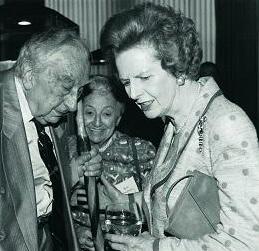
Margaret Thatcher with Milton Friedman one of the key architects of neoliberalism

Divide and conquer is the oldest trick in the book, but for the filthy rich, it’s the gift that keeps on giving

The hijacking and weaponising of national flags by extremists; the ramping up of racial and religious hatred on our streets; the promotion of identity politics and the ‘culture wars’; the spreading of outrageous conspiracy theories; Holocaust denial; attempts to portray all Muslims as extremists: the scapegoating of refugees and asylum seekers; calls for the mass deportation of essential, foreign born workers; victim blaming and the racialisation of social and political problems. This is all part of a coordinated campaign to destabilise Britain and pave the way for an authoritarian self-serving government masquerading as the saviours of society.

In 2018 Steve Bannon, investment banker, founder of ‘alt-right’ Breitbart News and former Chief Strategist for Donald Trump, famously set the tone when he advised his side that, “The real opposition is the media and the way to deal with them is to flood the zone with shit.” With Bannon’s guile and the likes of Elon Musk’s money the far right have created an online sideshow hall of mirrors where the wildest of conspiracy theories and the most malignant of misinformation is conflated with scientific research and verifiable facts.

The dirty war

While the hard right cynically sow confusion, distrust and ethnic/religious division amongst the working class the ruling elite and their lackeys prescribe the complete opposite for themselves.

In the dirty war against the working class their segregationist propaganda is merely a useful tool to divide us, but they know all too well that their own class interests are best served by mutually beneficial alliances across the ethnic, religious and cultural divide – an evident fact they do not want working class people to recognise.

Farage and Robinson – hired lackeys of the wealthy elite

But what of the UK’s two most prominent professional provocateurs, Nigel Farage and Tommy ‘ten names’ Robinson?

In common with many Reform UK politicians, Farage is a wealthy, privately educated, ex-Conservative Party member who passionately advocated for the Thatcherite economic policies that have undermined the nation he claims to love and created the very problems he now exploits to further his political career.

Deindustrialisation, chronic homelessness, the proliferation of Class A drugs, the rising cost of living and widespread societal breakdown did not arrive with the ‘small boats’. These were pre-existing conditions caused, in the main, by the political choices of the Thatcher administration and its successive UK governments, including Tony Blair’s New Labour, that slavishly applied the same, now discredited economic programme.

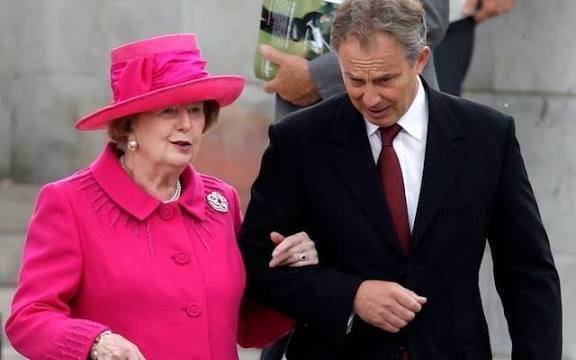
Former Prime Minister Tony Blair described Baroness Thatcher as “a towering political figure” whose legacy will be felt worldwide.
“I always thought my job was to build on some of the things she had done rather than reverse them”.

Operation Raise The Double Standard

While Farage encourages ethnic and religious division amongst the working class, he places no such restrictions on himself or his associates.

Reform UK is a multi-ethnic, multi religious party in which wealthy politicians of all faiths and none happily work side by side. These people don’t give a toss about each other’s backgrounds as long as they are making money together.

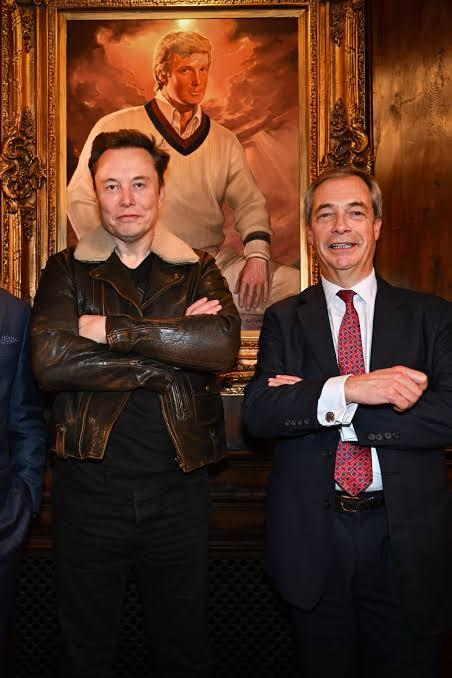
Elon Musk with Nigel Farage before Musk switched his allegiance (and money) to the Tommy Robinson camp

It is very telling that, while Farage gleefully whips up hatred and suspicion against decent working class people from Muslim backgrounds, he has no issue collaborating with those of the Muslim faith in his own party and, shamefully, with Islamic fundamentalist elites abroad. Revealing more of the man behind the ‘respectable’ mask he has openly stated that if he achieves office he will work with the Taliban, the enemy that Britain was at war with for twenty years ending in 2021, to repatriate individuals and families who have sought sanctuary in the UK from the horrors of the Afghan regime – a regime, let us not forget, that is still largely unrecognised internationally – in the full knowledge that he would be handing them over to almost certain torture and death.

Farage’s double standards regarding the Taliban not only expose his hypocrisy and indicate how comfortable he is in the company of murderous totalitarians, they also give us an indication of what deportation would actually mean in any future Reform UK type administration.

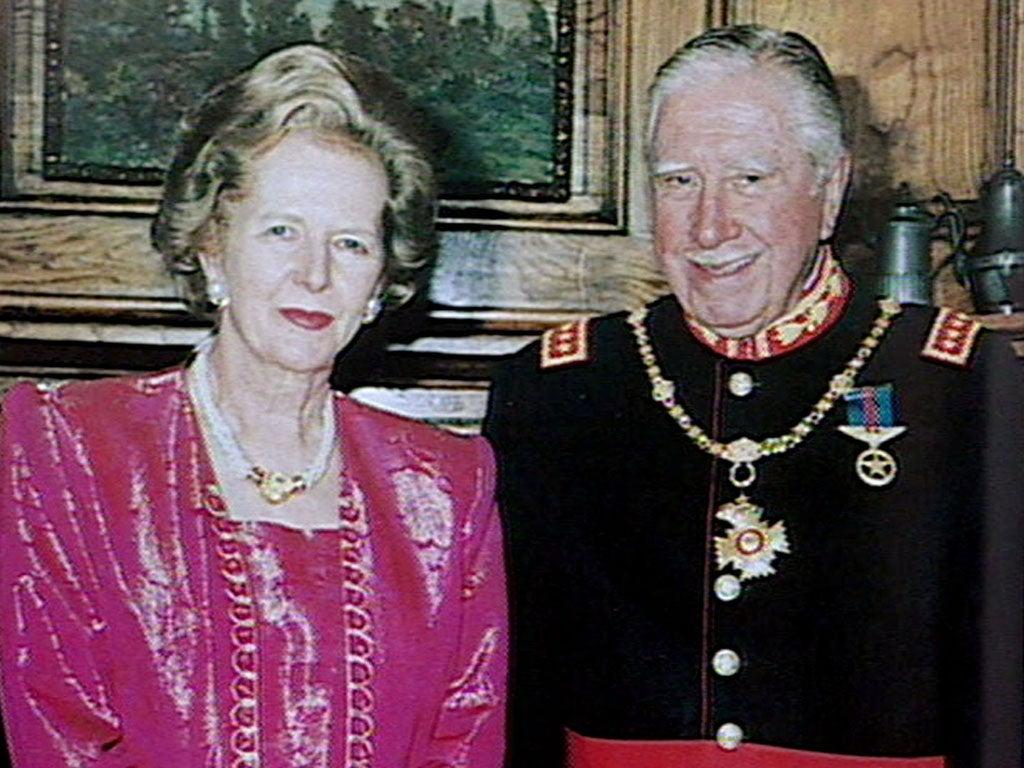
Farage’s hero, Margaret Thatcher, would no doubt have been very proud. Maggie was also rather partial to overseas dictators. She enjoyed a personal friendship with Augusto Pinochet, who seized power from Chile’s democratically elected government in 1973 through a US backed, military coup. Pinochet’s fascist regime was responsible for the systematic torture and murder of left wing opponents. Around 30,000 direct victims of human rights violations were recorded in Chile, with 27,255 tortured and 2,279 executed.

200,000 people suffered exile and an unknown number were ‘disappeared’. When Pinochet was finally indicted and arrested for crimes against humanity, Margaret Thatcher lobbied to have him released. Unfortunately, the tyrant died before facing charges.

The bloody fascist coup that birthed neoliberalism

Pinochet’s campaign of terror and brutality, waged against the democratically elected government in Chile and its supporters, cleared the ground for the South American country to become the pilot for the neoliberal economic experiment. Buoyed by the results in Chile, the Conservative Party and the Democrats, in the UK and US respectively, embraced the neoliberal philosophy and upon their consecutive election victories in 1979 the Governments of Margaret Thatcher and Ronald Reagan unleashed neoliberalism upon the wider world.

Thatcher with her friend, Augusto Pinochet, leader of the brutal military junta that overthrew the socialist government of President Salvador Allende of Chile in 1973.

The elephant in the room

The proverbial elephant in the room for the far right is that the authoritarian regimes they support are a major cause of the international refugee problem that they shamelessly exploit to further their political or ‘influencer’ careers.

Leaving aside historic cases such as the support for the aforementioned dictatorship in Chile and for the theocratic Mujahadeen in Afghanistan (the precursor to today’s Taliban), it is the support from British ‘nationalists’ for foreign ethno-nationalist regimes such as Likud in Israel and for proxy wars in Iraq and Syria (both incidentally fought against the backdrop of brutal totalitarian dictatorships) that exposes the cynical opportunism of their public stance against refugees. And if this wasn’t enough, the asylum seekers filling UK hotels are also lining the pockets of multi-millionaires who make substantial donations to these same right wing parties.

Until we dismiss the propaganda of these hate-fueled, right wing grifters, who appear to have a problem for every solution, we will continue to go around in circles. We need to recognise the symbiotic relationship between the authoritarian regimes that create the conditions driving the tragic merry-go-round of forced migration and the reactionary movements cynically undermining attempts by host countries to deal with the refugee crisis.

Refugees do not flee Scandinavian, left leaning democracies, Basque Country cooperative communities or other places where there is political accountability and a relatively high standard of living for working class people, they escape from the brutality of the type of ultra conservative, authoritarian dictatorships that the likes of Nigel Farage and ‘Tommy Robinson’ dream of bringing to the UK.

Refugees: the stats

Research by the United Nations, found that more people than ever live in a country other than the one in which they were born: ‘In 2024 the global number of international migrants was 304 million, a figure that has nearly doubled since 1990, when there were an estimated 154 million international migrants worldwide. International migrants comprise 3.7 per cent of the global population, having increased from 2.9 per cent in 1990. Female migrants constituted 48 per cent of international migrants’.

The United Nations Refugee Agency (UNHCR) estimated that, at the end of 2024, there were an estimated 43.7 million refugees across the globe, including 6 million Palestinian refugees. 8 million of these refugees were asylum-seekers.

‘Oh, Tommy Tommy…’

Farage’s fellow millionaire scam artist, Tommy Robinson (real name Stephen Yaxley Lennon), has also made a lucrative career promoting ethnic nationalism and anti-Muslim hatred.

Yet Robinson seems to have no issue with Muslims when they are lining his pockets. He is a member of Advance UK, an extreme right wing party that broke away from Farage’s Reform UK. Advance UK is led by the ex-Deputy Leader of Reform, Benyamin Naeem Habib, a wealthy Pakistani born Muslim. But the hypocrisy doesn’t end there; Tommy/Stephen has built a career positioning himself as the UK’s No 1 crusader against Islamic extremism yet, behind closed doors, he is funded and vociferously supported by the world’s richest man, Elon Musk – a close business associate of the brutal Saudi regime – the world’s top exporter of Islamist terror.

Tommy Robinson and Elon Musk also have a ‘complicated’ relationship with Judaism. Robinson recently reiterated his belief in the manufactured conspiracy theory of a Jewish plot to undermine western civilisation – a myth used by the Third Reich to justify the slaughter of around 6 million Jews in

WW2. Yet, despite Robinson’s propagation of this dangerous anti-Jewish myth, Benjamin Netanyahu’s extreme right wing, Likud government has welcomed him to Israel.

You can take the boy out of apartheid South Africa…

Tommy’s ally, Elon Musk, a South African Holocaust denier with familial links to the Nazis, is widely seen as a kingpin of the international fascist movement because of his funding and promotion of extremist propaganda and disinformation through his social media platforms. In full knowledge of all this he was appointed to the inner circle of the Donald Trump administration (and would probably still be there if not for the inevitable clash of egos that signalled an end to the grotesque bromance). A cosy friendship with another powerful President does endure though; like his puppet, Tommy Robinson, Musk also enjoys a cosy relationship with the Israeli Leader, Benjamin Netanyahu.

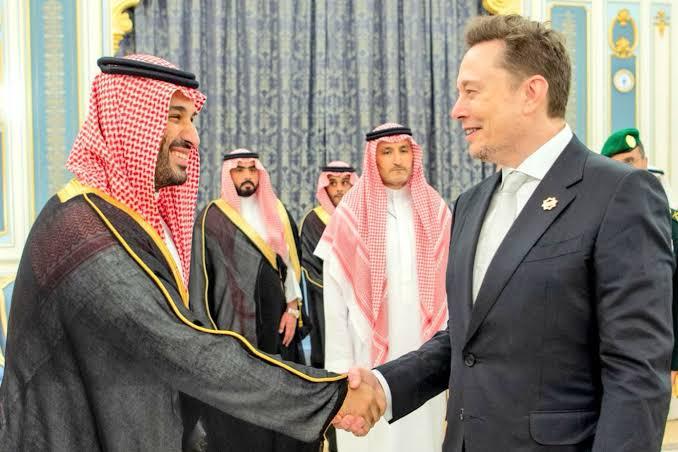
Saudi Crown Prince Mohammad Bin Salman with Elon Musk May 2025

Fascism doesn’t start with concentration camps – that’s where it ends

The far-right parties that came to power across the world in the early to mid 20th Century had common basic features which place them in the wider fascist family: an autocratic leader; ultra-conservatism; militarism; totalitarian ambitions; a belief in racial superiority; the need for a scapegoat; nostalgia for a mythic idyllic past; a view of women as domestic servants and most notably, a hatred of the organised working class. Although it is true to say that the rabid dog of fascism has a tendency to eventually bite off the hand that feeds it, as with today’s far right groups, the early fascist movements were routinely funded by elements of the ruling elite as a tool to suppress working class militancy.

Prior to the rise to power of the fascist movements of Benito Mussolini and Adolf Hitler, Italy and Germany had the most developed working class movements in Europe and the ruling class in both countries feared the possibility of a revolution for political and economic democracy. The short sharp shock of far right violence was seen by the ruling elite as a way of restoring their old corrupt order. Early into the flagship Italian dictatorship, trade unions were banned in order to prevent any organised resistance to the planned increase in production and drop in pay and working conditions. In Germany, once the Nazis came to power, they followed suit, abolishing trade unions and other workers’ organisations before setting up concentration camps for their predominantly working class, left wing political opponents.

In the 1930s the rise of fascism was a reaction to the strength of the organised working class. Today, conversely, fascism is re-emerging across Europe almost unchallenged because of the weakness of our class. For the first time in over a century the working class is bereft of a unifying philosophy and is without political or industrial organisation – a situation that has been deliberately engineered over the last forty years by governments who have faithfully followed the playbook of neoliberalism.

This relentless onslaught has cleared the field for today’s ultra-conservative ethno-nationalist groups who have crept out of the shadows without any need for the jackboot or iron fist. Through well planned, well funded social media campaigns recruits have been groomed and primed and are being encouraged onto the streets by their wealthy backers as a pre-emptive strike against a possible working class political renaissance.

Here in the UK of course, white nationalism is the horse that the super rich are backing. In a population where non-whites are in the minority, the dominant ethnonationalist strain is ‘White Nationalism’. However, historically and internationally, fascism was not, and is not the preserve of any one ethnic or religious group.

20th Century fascism adopted different qualities from country to country in order to tap into the culture and conditions of the particular region. If we take religion for example: Italian, Spanish, Portuguese, French, Irish and Croatian fascist parties had a very cosy relationship with the Roman Catholic Church (though early in the days of Mussolini’s dictatorship, Black Shirt membership was open to all, and included a number of Jewish members); Nazis in Germany had a diverse range of ideas on religion. Hitler held strong anti-Christian beliefs, while a few leading party members practiced orthodox German Protestantism and others were attracted to the Occult; in Japan, Emperor worship was promoted alongside the main religions of Shintoism and Buddhism; there were Muslim fascist legions in Egypt and the Balkans; Oswald Mosley’s British Union of Fascists had both Protestant and Catholic branches and the Indian Hindutva movement was Hindu separatist.

Hitler hosts the Grand Mufti of Jerusalem Haj Amin al-Husseini in 1941 in Germany. 

The nature of the beast

The dominant narrative, shaped by right wing actors, is that ethnic and religious groups are homogeneous. This is patently ridiculous. All societies have class antagonisms and understanding this helps us find a way through the dense forest of right wing black propaganda.

 While racism is invariably a component of ethnonationalism, the target of this racism varies according to the location of the particular far right organisation and, even then, can shift according to convenience.

British fascism wraps itself in the union flag, espousing white ‘Christian’ superiority to appeal to the majority population, citing ‘Jews, Blacks, Asians and Muslims’ (amongst others) as the enemy, but fascists in other countries choose different scapegoats, usually according to existing prejudices and enmities.

Paradoxically, understanding the breadth and diversity of fascism can help us get to grips with the core nature of the beast. So to this end, it’s probably worth a brief diversion to look at a range of ultra conservative movements that developed across the globe in the early to mid 20th Century.

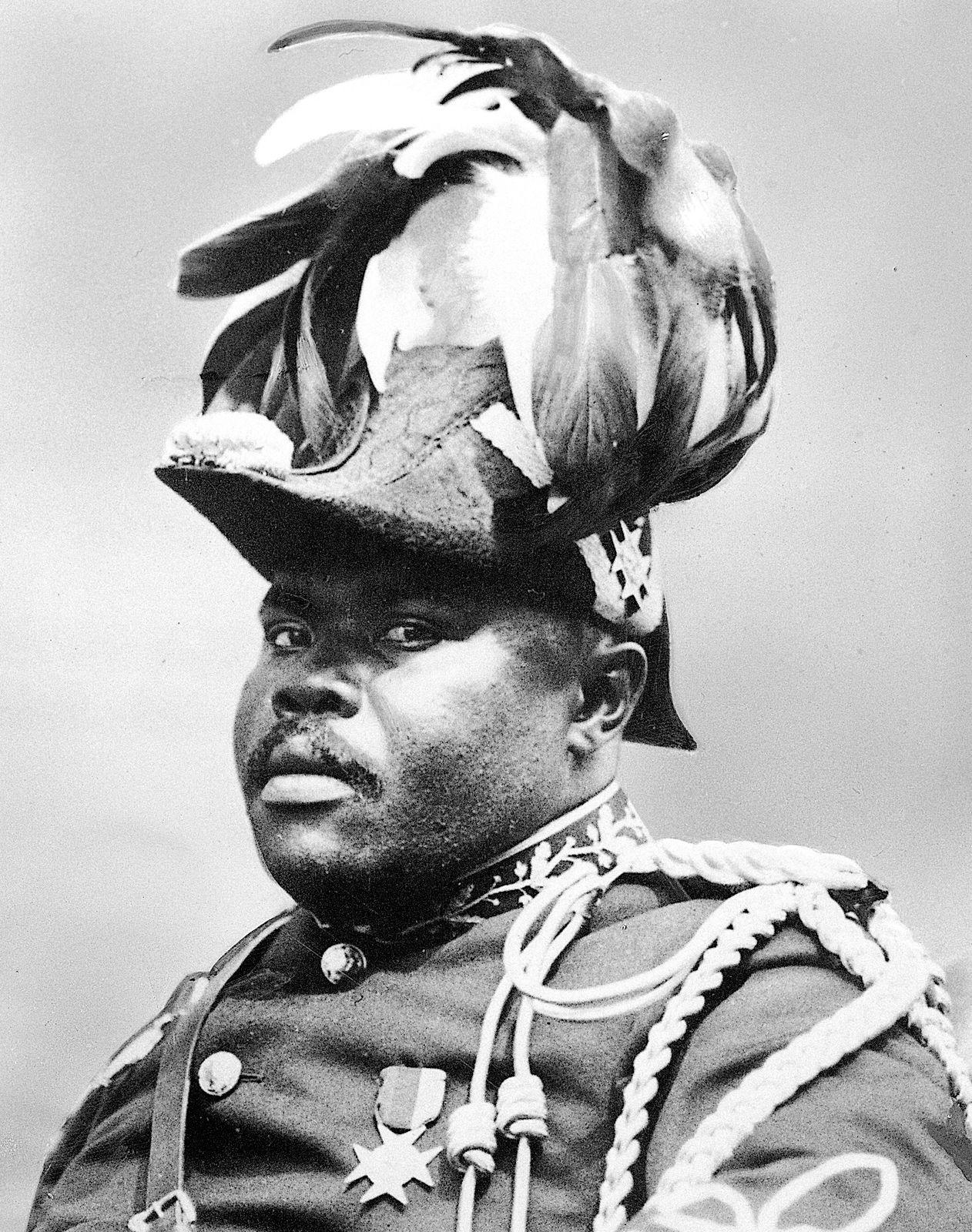
Marcus Garvey – ‘the first fascist’

Though he never achieved the power he craved, it is probably worth a brief look at the influential Black Nationalist, Marcus Garvey, to help us understand the nature of fascism. While it is important to recognise that, in practical terms, Garvey’s impact was to raise the confidence and consciousness of black people in the Western World who were subject to the most horrendous persecution, unfortunately, an examination of the man and his end game reveals a totalitarian dictator in the making.

The Jamaican demagogue was disgusted at Italian dictator, Benito Mussolini, for allegedly stealing his ideas. Garvey insisted that he was ‘the first fascist’ and if we look at the pompous home-made Napoleonic uniform, the Messiah complex, the racial separatism, the anti-Semitism and authoritarian tendencies, it’s hard to disagree with him. In Garvey too, we find the fascist phobia of miscegenation. He bitterly opposed “race-mixing” and regarded the Ku Klux Klan as ‘better friends of the [black] race, than any other whites’. Garvey also adhered to the all important (from a fascist perspective) hatred of the working class. His vision for a ‘Black State’ in Liberia excluded black workers, in favour of intellectuals and the well educated middle class (although he was happy to recruit working class members into his paramilitary security force, the African Legion). The African Legion was deployed, more often than not, to attack rival black leaders and organisations including black communists. It is important to note that at the time, Garvey and his reactionary ideas attracted robust opposition from prominent black intellectuals such as Frederick Douglass, Claude McKay, Pauli Murray and Frantz Fanon.

“We were the first Fascists, when we had 100,000 disciplined men, and were training children, Mussolini was still an unknown. Mussolini copied our Fascism.”
– Marcus Garvey

The Jewish far right

Regardless of the common perception that Jewish people are inherently anti-fascists; given the collective memory of the Holocaust, the truth is that in common with societies elsewhere, Jewish societies were/are subject to class division and with the setting up of the Israeli state, Jewish fascists finally had a national flag to rally behind.

As far back as December 1948, Albert Einstein and Hannah Arendt were amongst 29 prominent Jewish figures that signed an open letter to the New York Times airing concerns about the emergence of an extreme right wing Jewish party in Israel. The opening paragraph of that letter is worth quoting in full:

‘The most disturbing political phenomena of our times is the emergence in the newly created state of Israel of the “Freedom Party” (Tnuat Haherut), a political party closely akin in its organization, methods, political philosophy and social appeal to the Nazi and Fascist parties. It was formed out of the membership and following of the former Irgun Zvai Leumi, a terrorist, right-wing, chauvinist organization in Palestine’.

Benjamin Netanyahu’s Likud party can be seen as the heir to this early emergence of Israeli fascism. Likud is rabidly anti-Arab/Muslim and, as such, the party recently accepted an invitation to join other anti-Muslim parties from across Europe, as ‘an observer member’ on the EU fascist block, PfE (Patriots for Europe). The fact that many of these parties have previously espoused extreme anti-Semitic views and that they have a profound nostalgia for the regimes in their respective countries that played an enthusiastic part in the Holocaust, seems a moot point. For Netanyahu, who is currently the subject of a high profile corruption trial in Israel, it doesn’t appear to be the methods of the Third Reich that disturb him, but merely the ethnicity and religion of the victims. This is evidenced not only by his genocidal campaign against Palestinians, but also through his relaxed attitude to working alongside German far right party, the AfD, whose members have called for a ‘Srebrenica 2.0’ in reference to the 1995 Srebrenica massacre of more than 8,000 Bosnian Muslim men and boys in and around the town of Srebrenica during the Bosnian War, a massacre that was the first legally recognised genocide in Europe since the end of the Second World War.

Netanyahu also seems to have no concern about the backlash of anti-semitism being suffered by innocent Jewish working class communities across the world in response to his genocidal actions against the Palestinians and his alliance with anti-Semites. His own expansionist political agenda and personal ambition are obviously far more important to him.

The Israeli Lehi group who’s leadership, in 1941, attempted to make an alliance with both the Italian fascists and the Nazis

Fascism in the Islamic world

The inner circles of the Saudi Arabian, Iranian and Afghani Islamic elites also live the high life while many working class Muslims in these countries live in poverty and suffer brutality and murder if they fail to fall in line with the demands of the regime. These regimes closely resemble European fascist movements and it is often forgotten that some Muslims in the Middle East, fought alongside the Nazis in World War 2 – mainly over a shared hatred of Jews – motivated by Hitler’s cynical, pseudo scientific propaganda that Germans, Middle Eastern Muslims (and incidentally Indian Hindus) are all part of the ‘Aryan Master Race’. Other Muslim fascist parties who rose to prominence in the first half of the 20th Century include the Young Egypt Party (the Green Shirts) founded in 1933 and the Nazi SS Handar Division from Bosnia. European fascism also had a strong influence on the Baath Party in both Iraq and Syria and the Muslim Brotherhood which was founded in Egypt 1928.

Members of the Bosnian Muslim Nazi SS Handar Division

Imperial Japan

While the veneration of the leader is a staple feature of fascism, this reached another level in Imperial Japan. Here, the Emperor, who claimed direct descent from the Sun-Goddess Amaterasu, was literally worshipped. Likewise, the cult of death, destruction and martyrdom which permeates fascism generally was also taken very seriously. The Imperial regime demanded total sacrifice from its soldiers and this was demonstrated no more so than in the Kamikaze suicide attacks on US warships.

The Japanese case may appear, at first glance, too exceptional to qualify as fascist but an overview of its wider strategies suggests otherwise.

On achieving power, the regime waged war on the organised working class. Unions and left wing parties were attacked and decimated (incidentally trade union membership shot back up, very soon after the end of WW2 – much to the horror of the new US overlords); the regime harboured grand colonial ambitions; censorship was enforced by a Gestapo style secret police called the Kempeitai; the general population was indoctrinated into ideas of racial superiority and a nostalgia for the feudal Samurai past; the whole of society was militarised and women were kept subservient. While internal scapegoats were less of an issue in Japan than elsewhere, the regime was anti-Western, having a special loathing for the USA and also fostered an intense hatred and the racial denigration of China and Korea.

Japanese poster venerating Italian dictator Benito Mussolini

A class act or a race to the bottom?

Liberal analysis of fascism that reduces the phenomenon down to white racism is a dangerous misreading of history and a hindrance to understanding how to combat the current global resurgence in authoritarian politics. An analysis that insists that black people or Jews, for instance, cannot be racist or fascist fetishises both groups as somehow unique from the rest of humanity and removes agency; on the one hand casting perpetual victim status upon them and on the other, excusing the monstrous behaviour of autocratic leaders. This plays into the hands of segregationists, both white and black, as it concentrates our attention away from our shared humanity and common working class interests.

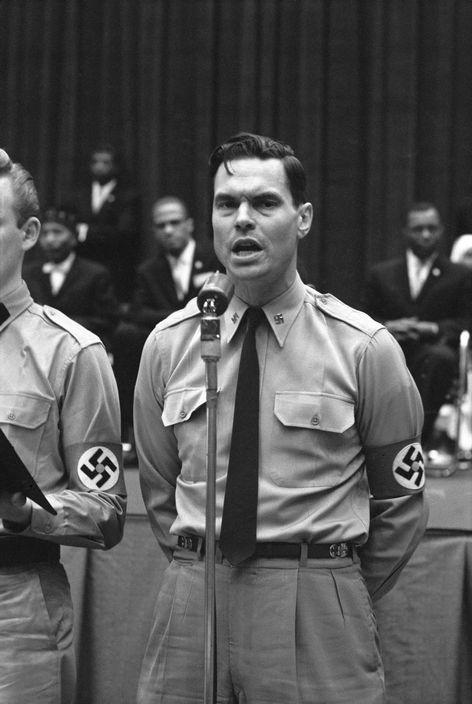
George Lincoln Rockwell, founder of the American Nazi Party addressing a Nation of Islam summit in 1961.

Thatcherism – The Road to Serfdom

Some of those who became obscenely rich as a result of the global application of the Thatcherite policies of privatisation and deregulation will, it appears, never be satisfied.

Aware that democracy, even in its most limited form, is stifling their James Bond villain level ambition, they look to authoritarian regimes across the globe, both historical and contemporary, for inspiration. It is important to understand that it is the authoritarianism of a regime, rather than its creed or colour that attracts fellow extremists and it is this authoritarianism that is key to understanding the superficial contradictions in both the Farage and Robinson camps. How else would we explain anti-Semites working with the Jewish Israeli state, anti-Islam activists partnering up with the Islamist Saudi and Afghani regimes and self-professed ‘British Patriots’ talking Britain down in the US and Israeli media and taking bribes to promote Russian business interests in the UK? These people are not patriots, they are narcissistic traitors out only for themselves.

If we view the world through the distorted lens of the mainstream media and online far right propaganda, it is no wonder that the picture often seems obscured and that none of this makes sense. But if we turn the binoculars around the right way, the picture comes into focus. When we view these political/financial relationships through the lens of cold hard economics and class interests, there is no contradiction at all. It’s the age-old story of greedy, amoral, self-serving elites and their fellow travellers forming convenient alliances to grab as much for themselves as possible at the expense of the rest of us. The alliances may shift as egos clash and brinkmanship comes into play, but they are always on the hustle and we, the working class, always pay the price.

These days, crackpot conspiracy theories are spewed across the political landscape like vomit on the Saturday night city streets. It is no coincidence that this confusing cacophony of nonsense serves to obscure the real, flesh and blood conspiracy of neoliberal capitalism’s creeping replacement by increasingly authoritarian solutions. Let’s be crystal clear; the super rich are uniting along class lines for the very reason they fear us doing the same – because it is a winning strategy.

Don’t be mugged off. Don’t be fooled by their lies and disinformation. The clock is ticking, but we still have time to turn things around if we pull together. We need each other now, more than ever.

The Great Asylum Hotel Swindle 

Only a fool would believe that the decision of Boris Johnson’s Conservative Government to use hotels to accommodate large numbers of refugees in already hard pressed working class areas, was a good idea – especially considering the damage already done by New Labour’s ban on asylum seekers gaining employment and contributing to society, making them dependent on state support.

It’s notable that asylum seekers and refugees are seldom, if ever, placed in hotels in middle class or wealthy areas and that the venues chosen are predominantly within working class communities where resources are already stretched and morale is at an all time low, following decades of successive governments’ right wing economic policies.

https://www.theguardian.com/commentisfree/2025/aug/09/britain-asylum-hotels-racism-culture-war

For all the hysteria and mock outrage, in contrast to the fortunes of working class communities and asylum seekers, for the Conservative Party and its Ultra Conservative Frankenstein’s Monster, Reform UK, ‘migrant hotels’ have been both a lucrative cash cow and political mana from heaven.

Laughing all the way to the bank: Firoz Kassam’s Asylum Hustle  

The privatisation of the Asylum system gifted millions of pounds of easy money to shameless, rack-renting, slum landlords. The Holiday Inn, on the edge of Blackbird Leys, the scene of recent Asylum protests, is owned by Firoz Kassam. Kassam is a canny businessman who bought Oxford United for £1 and was gifted the land by Oxford City Council for less than half the market value enabling him to build both the Kassam Stadium and the Holiday Inn. He is justifiably an unpopular figure locally for forcing United out of the stadium in order to free up the land for even more profitable use. Yet the Oxford United story is only the tip of the iceberg.

https://www.oxfordmail.co.uk/news/1769534.stadium-sale-good-value/

Having amassed a fortune in the 1980s from government handouts for housing homeless people in his notoriously putrid Mount Pleasant Hotel in Kings Cross, Kassam came early doors to the asylum racket. In 2000, long before the far right recognised the issue as politically useful, Kassam made headlines over his London Park, ‘Hostel from Hell’, where according to newspaper reports, some residents felt even more unsafe than they did in the war torn countries from which they had fled.

https://www.theguardian.com/uk/2000/jul/09/immigration.immigrationandpublicservices

It is important to note that Kassam and other hoteliers who hit the jackpot at the taxpayers expense through housing asylum seekers, repaid the favour, with substantial donations to the Tory Party.

https://www.theguardian.com/politics/2006/jun/02/conservatives.uk3

The Failure of Government Asylum Policy

While Kassam raked in the money, the Holiday Inn, Blackbird Leys, became home for refugees from across the globe and for four years, there had been no obvious fuss and no outcry of opposition from local residents. Fast forward to last summer’s ‘Farage Riots’ and still no trouble at the Holiday Inn and it remained that way until 3 weeks ago when a sorry looking stranger with a placard and two elderly women with a dog rolled in. The following Saturday saw the same motley crew turn up, and it would probably have been the same the next week, but emboldened by the High Court ruling that the former Bell Hotel in Epping must stop housing asylum seekers, Nigel Farage called for national protests and the small group of zealots outside the Holiday Inn increased slightly, their ranks swelled by locals living next to the hotel who appeared to be more animated by the slogans and megaphones of the much larger and more organised counter protest than anything else.

Yet, while right wing opportunists have waited on the sidelines until the issue of ‘Asylum hotels’ became politically useful, more sober heads had been airing concerns about government policy for a number of years. One such group is the Refugee Council, founded in the wake of World War 2 to address what was at the time, an unprecedented refugee crisis, which recently reiterated its position on the issue:

“Everyone agrees that hotels are the wrong answer: they cost the taxpayer billions, trap people in limbo and are flashpoints in communities. Through our frontline work, we see how protests and hostility leave people who have fled war and persecution feeling terrified and targeted in the very places they are forced to live. Ultimately, the only way to end hotel use for good is to resolve asylum applications quickly and accurately so people can either rebuild their lives here or return home with dignity. This will cut costs and allow refugees to integrate into their new communities, contribute, and play their part in Britain.”

Locally, the Independent Working Class Association, which represented Blackbird Leys on Oxford City Council between 2002 – 2012 also tried to address the issue:

‘..As a rule political refugees are housed in the most under-funded areas which are duly expected to share out already meagre resources with the new arrivals. Across the country, the government is shown to have repeatedly short-changed councils to whom refugees are allocated. The interests, concerns and sensitivities of local communities are also routinely dismissed. Unsurprisingly this can be a source of suspicion, tension and resentment.’

IWCA Manifesto July 2003

Unfortunately the mainstream parties had no such consideration for local communities, so it was full steam ahead with no visible strategy for managing the impending crisis. Given the political climate, a disenfranchised working class and a relentless, extremely well funded campaign of disinformation on social media, it was almost inevitable that a quasi messianic autocrat with a pocket full of promises would emerge. Enter, stage right, Nigel Farage, who had cynically positioned himself to profit from the misery caused by the application of the very policies that have served him and his class so well.

Traitors?

The extreme right wing element at recent anti-asylum protests have attempted to label anyone who refuses to be bullied into adopting their hateful world view as a ‘traitor’, but if a traitor is one who acts against the national interest, maybe they should look a little bit closer to home.

Nigel Farage was a member of the Conservative Party from 1978 to 1992. He was, and remains, a passionate supporter of the party’s anti-working class, neo-liberal economic policies. In 1979 when Nigel’s idol, Margaret Thatcher, came to power, the gap between rich and poor was lower than at any time in recorded history. Four decades and counting into the neoliberal experiment, and that gap has widened to Victorian proportions, leaving many of our once proud working class communities on their knees. The use of food banks has increased by 51% in the last five years, while over the same period, wealth inequality has risen at a staggering rate with the UK’s 50 richest families now holding more wealth than 50% of the population.

https://www.trussell.org.uk/news-and-research/latest-stats/end-of-year-stats

The political right loves to bang on about ‘Broken Britain’, but they conveniently fail to mention that they broke it.

The Thatcher Government’s widespread privatisation of public services (more than 40 UK state owned businesses were sold off between 1970 and 1990), resulted in billions of pounds of public money being syphoned off into the private bank accounts of overseas venture capitalists. Today, it is the public utilities sector where the impact is most keenly felt. If we’re looking for a prime example of an individual beneficiary of the privatisation of UK utilities, we need look no further than the aptly named Hong Kong billionaire, Li Ka-shing. Ka-shing, was recently paid more than £2 billion pounds in dividends as a director of the CK Group, owners of UK Power Networks, the company that supplies electricity to the South East of England. Ka-shing’s cut is just a fraction of the astronomical figure that has been lost from the UK Exchequer through the privatisation of our utility services. 

When the Game is up, Move the Goalposts

It has become more and more difficult for those on the right to keep up the pretence that Thatcherism has been anything but an unmitigated disaster for the UK. The physical and emotional scars of Thatcherite policies blight the landscape of contemporary Britain. This can be seen more than anywhere else, in the former industrial heartlands, where working class solidarity, dignity and industry has been replaced with unemployment, poverty, zero hours contracts and heartbreaking social decline. This is the legacy of Thatcherism and millions of voters know it, which is why, if the elite want to cling to power, Conservatism needs a rebrand – and you can guarantee that the Reformed version will be even more vicious. 

https://www.theguardian.com/commentisfree/2022/jun/22/the-guardian-view-on-privatisation-the-god-that-failed

https://weownit.org.uk/public-ownership/energy

Old Wine in New Bottles 

Reform UK has nothing to offer working class people. Farage is a well connected millionaire; the product of an elite private school and very much a part of the British establishment he claims to oppose. His party is bankrolled by a particular type of wealthy individual who would have traditionally donated to the Conservatives but now feel that Reform better represents their interests. These people would not be investing in Reform UK if they thought for one minute that the party would consider reintroducing a fair tax system or implementing any other form of wealth redistribution to help tackle rising inequality. Independent international media platform, Open Democracy, report that ‘Farage’s party has sought to frame itself as an alternative to the political status quo of the Conservatives and Labour, yet this is at odds with its wealthy funders, many of whom are longtime political donors and paid-up members of the elite’.

https://www.opendemocracy.net/en/dark-money-investigations/reform-uk-funders-nigel-farage-5-million-donations-fossil-fuels-tax-havens/

Nigel Farage and his Limited Company, Reform UK, are happy to whip up hysteria over desperate people arriving in small boats, but they turn a blind eye to the moral bankruptcy of the likes of Firoz Kassam and other multimillionaire beneficiaries of the Great Asylum Hotel Swindle who are milking millions of pounds from the public purse to fund their luxury lifestyles in Riviera tax havens – tax havens incidentally, from which Reform UK receives 10% of its donations. Farage may self identify as a ‘man of the people’, but we’re having none of it.

The Politics of Asylum

Blackbird Leys Community Spirit’s Joe Kenehan discusses, from personal experience as a volunteer English teacher with asylum seekers, the negative impact that asylum and immigration policy has on migrants and society alike:

While Britain’s duty to give asylum to people fleeing war, oppressive regimes, torture and persecution shouldn’t be up for discussion, two important aspects of the problem should: one is Britain’s role in propping up or contributing to what causes people to flee their countries; the other is what happens when people get here as refugees. This article concentrates on the latter.

In my experience as a volunteer teacher of English to asylum seekers and refugees, I learned that my students came here looking for freedom, but their idea of freedom is defined in negative terms: not being persecuted, not being kidnapped to serve in the army indefinitely, not being tortured, etc. They were elated at the prospect of being able to hop on a coach and go to a different city without needing a permit from the police or the army. But if I asked them what the three powers of the state are and why they should be separate for a country to be democratic, they were stumped. If I asked them what a jury in a court case is, they didn’t have a clue. The idea that hearing voices might be a medical condition and not the result of having been “touched by the devil” was also new to most of them, and when I explained that the child that was thrown out of the village and abandoned in the wild had actually needed medical attention, they looked shocked and sorry for what had been done.

Asylum seekers and refugees, especially those from Muslim countries, have often been taught at an early age that a sin is a crime, and questioning their religious leaders (who often doubled as political leaders) is a sin and therefore also a crime. Critical thinking is actively suppressed, and knowledge of political ideas, civil rights or anything to do with being part of society is strictly limited to what their leaders say the Koran says. In other words, most of my students came here carrying a fascist ideology they have never even compared to any other ideology, let alone discussed or analysed.

To make things worse, after 30 years of multicultural policies that have managed to flip the meaning of “segregation” into “safe space”, coupled with cuts to services meant to facilitate integration, asylum seekers’ main source of help and information when they arrive in the UK are bedfellows of the conservative religious leaders that dominate the political landscape of the homelands they had escaped from. Refugees find themselves in a bubble in which the only contact with outsiders is with volunteers and English teachers.

And here’s the next problem: English teachers teach English language, not English culture. English culture, including citizenship and other important aspects of living among British people, would be considered oppressive indoctrination with a typically colonial aggression against students’ “identity”. Plus, a lot of English teachers are not equipped to discuss citizenship, politics and ideology.

But discussions of that kind are exactly what is needed (as opposed to frontal attacks that would cause defensive walls to rise instantly). And this is the next thing: none of the people I taught ever declined to engage in a discussion – quite the opposite. They were eager to engage. Any point is a good entry point: I was even able to discuss the separation of religious institutions and the State, which, for religious people coming from clerical-fascist states who take their knowledge from religious leaders, might be considered a taboo subject. I asked my students to tell me the story of Abraham, and then I asked them what they would do if one day, coming out of the mosque, they saw a man with a knife to a boy’s throat. Would they call the police if the man told them God was asking him to sacrifice his son to him? They said yes. And I said that this was because they didn’t hear God the way the man said he did. Which is why we need rules that allow us to live together, regardless of what some of us think God is telling us he wants, and that we must agree that if an action is a horrible sin against God according to an interpretation of the Scriptures, but not against other people, we should leave it to God to punish the perpetrator.

My students attended other classes aside from mine. They were impatient to learn English, and attended any class in town that any organisation offered. The thing that would probably surprise liberal identitarians and the far-right equally is that my students complained that none of the other teachers ever told them about “these secrets of Britain”, as they called them, that we had discussed. The students could never have enough discussion and I believe wholeheartedly that, as progressives, we need to encourage this as much as possible. We need to face the fact that many refugees’ and immigrants’ core beliefs are often at odds with Western democratic norms, and acknowledge and address the unconscious fascism that those raised on a diet of religious bigotry carry with them.

We cannot allow freedom from being offended to be touted as a human right, or respect for ‘diversity of culture and religion’ to be used as a smokescreen for those who wish to undermine our secular state. It is an unquestionable fact that this country is being pushed further and further to the right by self-interested old Etonians and their allies. An asylum policy that actively locks refugees into an echo chamber of unexamined religious dogma and swells the numbers of the socially ultra-conservative, only serves this rightwing agenda – whatever the liberal left might have to say on the matter.

Blackbird Leys Community Spirit

Working Class Pride Worldwide

The history of our end of East Oxford is steeped in stories of heroism, resistance, self-sacrifice and collective struggle in the cause of freedom, yet if you relied on the school curriculum and most of the history books you’d be forgiven for believing we have nothing to be proud of. Much has been done over recent years to undermine our once proud working-class communities, from unfair housing policies, to the promotion of selfish individualism personified, at street level, by the county-lines drug dealer who profits off the vile abuse of children and the misery of others. The vast majority of Blackbird Leys residents are good, decent people, but unfortunately, the lumpen, anti-social minority receive most of the attention. Yet things were not always this way, as the following article explains, and there is no reason on earth, that we couldn’t and shouldn’t work together to isolate the selfish few for the benefit of the rest of the community. 

Rebels, orphans and freedom fighters

From the moment the first housing was occupied in Blackbird Leys (then Cowley) at the tail end of 1958, our estate has been home to people from a wide variety of backgrounds who have come together as one community.

Some of the first residents to arrive came from established, tightly-knit communities in the city centre as casualties of what town planners dismissively labelled ‘slum clearances’ as well as from temporary housing at the abandoned army barracks at Slade Camp. 

Others came to the area to work at the Cowley car plant from rural Oxfordshire, a county steeped in rebel history. They included some whose recent ancestors had faced the hangman or transportation to Australia for their activism. Otmoor, just seven miles from Blackbird Leys, had witnessed a major rebellion in 1830-31 over attempts by the University and Clergy to enclose the moor where the fiercely independent local villagers grazed their geese and livestock. This revolt saw inner city residents and rural communities work together against the common enemy, culminating in a successful skirmish at St Giles’ Fair where soldiers were forced to free Otmoor rebels they were attempting transport to Oxford Prison. A number of other nearby villages, including Nuneham Courtenay (three miles south of BB Leys), were involved in the ‘Captain Swing’ movement. Swing activists organised against the tithe system, which required payments to support the established Anglican Church; Poor Law guardians, who were accused of abusing their power over the poor; and rich tenant farmers who had been progressively lowering workers’ wages while cost cutting through the use of agricultural machinery. The Captain Swing disturbances represented the largest episode of political unrest in English history, with more than 3,000 cases of arson, attacks on authorities and machine-breaking across 45 counties. 644 activists were imprisoned, 505 transported to Australia, and 19 were executed. 

Unemployed workers also made their way to Cowley and Blackbird Leys from the former industrial heartlands of Britain and Ireland, together with a number of proud Caribbeans answering the call for workers in ‘the Motherland’. Others found themselves in the city after being evacuated as children from London during the Second World War. These were joined by Italian and German internees who remained in East Oxford after being released from Slade Camp, and by orphans and foundlings from Nazareth House who had been shown the door upon reaching adulthood. A number of heroic Polish soldiers who fought with the allies against Nazism, before becoming exiles following the Stalinist occupation of their homeland, also settled here. In addition to these early Blackbird Leys and Cowley residents, came many individuals from other parts of the world, such as the lady who married an Oxford man and later moved with him to the estate, following a love-at-first sight encounter with her future husband when he was posted to her small village in Malta as a sailor in the Royal Navy in WW2.

The Fighting Spirit of East Oxford

The fighting spirit of East Oxford’s industrial working class can be traced back three decades before the bulk of Blackbird Leys was built – to 1934, to be precise. This was the year that saw the first strike for union recognition at the Pressed Steel factory (on the edge of what was to become Blackbird Leys). Pressed Steel supplied car bodies to Morris Motors, whose owner, William Morris (later Lord Nuffield) dominated the political landscape. Morris was fiercely anti-union. He was also a close friend and an early financial backer of Sir Oswald Mosley, the soon-to-be infamous leader of the British Union of Fascists. Morris funded Mosley’s first fascist party and showed his enthusiastic support when the BUF leader held meetings in Oxford City Centre.

Cowley soon expanded from a small village into a vast industrial centre and the population increased accordingly, through the influx of workers from depression-hit areas of the UK who came to seek work at the booming car plant. A number of the largest group of these impoverished migrants had made their way on foot and bicycle from the South Wales coalfields, where miners and their families were literally starving to death. The former miners’ brought with them a strong sense of industrial and community solidarity, born of the experience of working underground where their lives literally depended on each other. This soon pitched them at the forefront of the battle to improve wages and conditions at the Cowley car plant. 

Pressed Steel Strike

The Pressed Steel Strike broke out on Friday 13th 1934 as a result of night-shift workers discovering that they had been underpaid, bringing to a head simmering tensions over piece-work wages. Workers pitched tents in Johnson’s field opposite the car factory where they received support from the family that ran Johnson’s Cafe. A young communist firebrand named Abe Lazarus arrived to help out (disregarding the lack of interest from the party leadership) and soon won the hearts of local people. Lazarus was born in London’s East End to Jewish and Irish parents. He had recently earned the nickname Bill Firestone through his involvement in a famous strike at the Firestone tyre factory in London. As he was facing police charges over picketing activities during the London strike (that were later dropped), he adopted the name Bill Firestone to avoid arrest when he first arrived in Oxford. The Pressed Steel strike was victorious with the factory management conceding to the strikers demands delivering a return to work with a guaranteed basic hourly rate, no victimization and full union recognition.  Abe Lazarus/Bill Firestone, who had taken a job at the City of Oxford Motor Services (Oxford Bus Company), remained in the city, where he played an enthusiastic part in local working class campaigns, for a number of years. For some time, Abe lodged in Garsington Road, Cowley, (ironically facing the spot where the Nuffield Needle, a monument to his nemesis, now stands). At its peak, Abe’s Transport & General Workers Union, became one of the strongest industrial unions in the UK, with Cowley playing a major part in its success.

Anti-Fascist Resistance

Both Abe Lazarus and a number of Welsh Cowley workers were at the forefront of the early resistance to fascism in the City, having played a pivotal role in crushing a meeting of Mosley’s British Union of Fascists at the Carfax Assembly Rooms in 1936. The Blackshirts were supported by local dignitaries from the University and local industry, including William Morris (who sat in the front row). While Cowley car and bus workers proudly took a stand against right-wing extremism, the elite openly paraded their support for fascism. At the time, in addition to the BUF, Oxford University had both German National Socialist and Italian Fascist societies. 

As well as courageously fighting against Mosley’s Blackshirts, two Cowley based men, Alfred Smith, a Morris Motors worker, and Victor Claridge, a builder’s labourer, joined the thousands of working class volunteers who travelled to Spain with the British Battalion of the International Brigades to oppose General Franco’s fascist coup against the democratically elected Socialist government. Alfred, who had a metal plate in his head from the First World War, was 47 when he left for Spain – much older than most volunteers. Victor Claridge had previously travelled to Canada and the USA and received weapons training in the US National Guard. Like many US International Brigade volunteers, he had also been active in the Industrial Workers of the World – a militant industrial union in the USA that organised amongst low-paid, often immigrant labour. IWW members famously stood up to employers and their militia, and took up armed defence against attempts by the Ku Klux Klan to intimidate its members. Claridge had been deported from the USA to the UK in 1930. In Spain, he was wounded at the Battle of Jarama (Feb 1937) and, after recovering, fought in the Battle of Brunete five months later, before being repatriated back to England for health reasons in October 1937.

The Longest Day

In World War 2, Cowley also played a proud part in one of the truly monumental episodes in the international fight against fascism. Slade Camp was used to train soldiers for ‘Operation Overlord’ (D Day), planned for June 6th 1944. ‘D’ Company, 2nd (Airborne) Battalion, Oxfordshire and Buckinghamshire Light Infantry, who were based at Cowley Barracks, played a pivotal role in the success of the largest military operation in UK and US history. 

D Company, a special unit of volunteers which was formed two years prior to D Day, was commanded by Major John Howard, who, unusually for an officer, came from a tough working class background and, prior to enlisting, worked as a beat copper on the streets of Oxford. Howard became great friends with the unit’s oldest Lieutenant and fellow Cockney Den Brotheridge. Both came up through the ranks. Both commanded deep respect from their men (at least a dozen of whom had lied about their age to enlist). Stephen E. Ambrose, author of Band of Brothers and Pegasus Bridge, paints a telling picture of the close relationship between officers and men, away from the gruelling discipline of the daily fitness regime necessary to produce such an elite squad: ‘Brotheridge stood out from the other officers. He played the men’s game, soccer, and as a former corporal himself, he had no sense of being ill at ease amongst the men. He would go into their barracks at night, sit on the bed of this batman, Billy Grey, and talk soccer with the lads. He got to bringing in his boots along and shining them as he talked. Wally Parr never got over the sight of a British lieutenant polishing his boots himself while his batman lay back on his bed gassing on about Manchester United and West Ham and other soccer teams.’ 

The specially created Airborne Division of the Ox & Bucks were tasked with ‘Operation Deadstick’, which entailed landing Horsa gliders behind enemy lines a few minutes after midnight on D Day, capturing two vital bridges to help secure Sword Beach from German heavy armoured divisions, and preventing the British 6th Airborne Division from being cut off from the rest of the Allied Armies. The Cowley-based unit, with the assistance of the heroic French Resistance, were the first soldiers to set foot on French soil on D Day. Den Brotheridge was the first man to lose his life. A few hours later, more soldiers from the Oxon & Bucks regiment landed by sea on the beaches of Normandy to play their own valiant role in the successful operation to liberate Europe from Nazi control. Cowley men attached to 249 (Oxfordshire Yeomanry) Battery of the 63rd Anti-Tank Regiment, were also the first allied soldiers to enter and liberate the Bergen-Belsen concentration camp on 15 April 1945. 

Back home, the Cowley car plant was adapted for war work and Cowley Airfield (now the park at Blackbird Leys Bridge) became the HQ of No 1 Civilian Repair Unit, where 100s of damaged aircrafts, including Battle of Britain Hurricanes and Spitfires, were repaired.

So next time you pass over Blackbird Leys Bridge as the youngsters below are kicking a ball around on Cowley Airfield, spare a thought for the British and Polish fighters whose sacrifice won the Battle of Britain. When you pass by the Car plant think of the struggle and solidarity of those early workers, and their hunger march to Oxford from South Wales. When you approach the Nuffield Needle, think past the official history of William Morris, the great philanthropist, and dwell for a while on his fascist sympathies and on the fighting spirit of the young Abe Lazarus who opposed him. When you look at the factory from the ring road, remember those brave young men who trained for D Day at the Slade Camp and on the hills of Shotover, and while travelling out of Blackbird Leys, remember the villagers who risked the hangman’s noose or transportation to prison slavery in the blazing Australian sun, to stand up for their collective dignity.

This is just a summary of some of the proudest moments in our local working-class history and in time, we plan to focus on some of these particular stories in more depth. We would be happy to hear from residents that feel they may be able to add to our knowledge through their own research or family memories.

Whether you’ve lived in Blackbird Leys all your life or you’ve just moved to the area, if you share our interest in improving our community, please get in touch. It’s time to take inspiration from the past and pull together to take our communities back.

Blackbird Leys Community Spirit is a new organisation committed to promoting working-class pride, dignity and self-respect and to bringing together like-minded local residents. 

Founding members of BBL Community Spirit include former members of the Blackbird Leys Independent Working Class Association, who have years of experience at the sharp end of community activism. The BBL IWCA was a grassroots organisation active on the estate from 1999 until it’s disbandment in 2017. The IWCA is best known for its high-profile community campaigns, most notably against drug dealing, and its youth work with the IWCA Athletics Club.

Saïd  Business School 

The Elephant in the Ivory Towers

‘I would like to pay tribute to the Rhodes Must Fall campaign who have seen their aims come a big step closer today, and also to the Black Lives Matter campaigners who have reinvigorated this debate about our history and how it should be recognised’.

Councillor Susan Brown Leader of Oxford City Council.

In light of Oriel College’s decision to remove a controversial statue of colonialist diamond magnate Cecil Rhodes, it would appear that Oxford’s Rhodes Must Fall/Black Lives Matter campaigners are now accepted as arbitrators of who or what is to be considered offensive in the City. Evidently, cherry-picking history, to suit a racialised, economically conservative agenda, is now acceptable currency amongst the City’s ‘educated’ elite. 

Propaganda, it would seem, trumps truth.  While liberals will no doubt be elated at recent developments within campus politics, anti-racists would be wise to be cautious, as the triumph of those pushing an ideology that places race as the determining factor on which injustice is to be judged, has serious implications for the struggle for social and economic liberty. 

Advocates of the Rhodes Must Fall and Black Lives Matter groups paint a distorted picture of history and current affairs by airbrushing out inconvenient truths that conflict with their agenda. Focusing primarily on historic crimes committed against black people by white imperialists is to lose sight of the fact that black people have their own monsters too and that there will be no shortage of such monsters while the type of unfettered, hierarchical systems that produce them continue to exist.  In order to deny the historical fact of humanity’s common inhumanity – a revelation which compromises cultural nationalists’ claim of special status for black people as ‘the wretched of the earth’ – activists adopt a swivel-eyed approach to both past and present. This approach has inevitably burdened campaigners with an obligation of omertà when it comes to the victims of ‘modern’ slavery, even where a disproportionate number of the victims happen to be black and brown.

For all the radical posturing of Rhodes Must Fall/Black Lives Matter activists, the reality is that by racialising social and political issues at the expense of a progressive class analysis, they offer no threat to the economic system. This is why corporations, politicians and other establishment figures are more than happy to be associated with the BLM movement. A few more black faces at the top table, it has been concluded, is a small price to pay to ensure the future of capitalism (a logic that, we can be sure, hasn’t escaped the attention of the more ambitious activists).

Black lives, so the mantra goes, matter. Yet, even by their own race-obsessed identitarian standards, the city’s privileged protesters stand guilty of rank hypocrisy. The focus on historic, colonial injustices and a one-size-fits-all, US-media-driven narrative at the expense of acknowledging the ongoing, global suffering of millions of working class and impoverished black people, exposes the fraudulent nature of the project.

Furthermore, the absurd notion of ‘white privilege’ incanted by protesters who insist that all white people are advantaged over all black people, rings particularly hollow across the working class estates of East Oxford – especially when expressed by privileged black middle class students and their allies. Despite the odd, half-hearted nod to class inequality from the speaker’s platform, BLM/RMF protests have proved to be safe spaces for the incubation of racial bigotry; spaces where cries of ‘Fuck white people’ go uncontested and right-wing religious zealots hold court. Whatever the motivation of protest organisers, the message being received across the city is one of white = bad, black = good, and this has fostered an unprecedented atmosphere of racial tension. We are seeing the emergence of an ‘if you’re not with us, you’re against us’ online bullying culture, especially amongst young people. Within this environment, even the most stalwart critics of bigotry have been branded racist because they have not reposted BLM propaganda (and woe betide any youngster who dares to question the dominant narrative!). Ethnic nationalists on both sides will inevitably be rubbing their hands together with glee at the further prospect of racial disharmony.

Despite the ‘black lives matter’ rhetoric, campaigners have shown no interest in bringing the University to task over its continuing policy of accepting blood money from regimes that stand guilty of ongoing human rights abuses against black people. While I am not suggesting that Cecil Rhodes was anything other than a monstrous human being, the fact that dead white tyrants such as Rhodes are being held up to higher moral standards than latter day tyrants (of any skin tone), again, reveals inconsistency and a lack of joined-up thinking across the ‘educated’ side of the city. One could argue of course, that campaigners should not be bound to protest every injustice. Yet, as the protestors themselves have chosen to focus on the University’s links to individuals and systems that have profited from the brutal exploitation of black labour, this logic does not apply in this instance. It is more than legitimate to question why campaigners have restricted their attention to one particular historical figure, while ignoring other equally worthy candidates. A genuine movement that insists on the dignity of black lives would at least use the publicity generated by the Rhodes Must Fall campaign to highlight and challenge Oxford University’s current connections to brutal overseas governments.

A case in point would be Oxford University’s Saïd Business School, which is funded by the grotesque dictatorship of Saudi Arabia, a regime with an horrific domestic human rights record, a murderous foreign policy (aided and abetted by the UK government) and an unrivalled reputation as an exporter of Wahabi jihadism. 

The Saïd Business School was named in honour of billionaire arms dealer Wafic Saïd, who initially made his fortune in the Saudi construction industry where conditions of ‘near slavery’ and inhumane abuse have been condemned by Human Rights Watch and Amnesty International.

Saïd was a close friend and significant financial supporter of British Conservative Prime Minister, Margaret Thatcher. He was especially vocal in his admiration for Thatcher’s campaign against the National Union of Miners in the 1984–85 Miners’ Strike. The war on the NUM was the first step toward the Thatcher administration’s ultimate goal of dismantling British heavy industry and privatising almost everything else. By destroying the NUM, which was widely considered to be the backbone of the trade union movement, and then picking off all other instruments of resistance, the Thatcher government gifted itself a free hand to implement its neoliberal economic policies. Thanks to the political decisions of Thatcher’s Conservative Government, enthusiastically supported by Wafic Saïd, many of our once proud and relatively prosperous working class communities have been transformed into post-industrial wastelands, with high unemployment and the type of acute social problems that would have been unimaginable a generation ago. 

The perfect complement to the Rhodes Must Fall campaign would then surely be a movement to put pressure on the Saïd Business School to change its name and on Oxford University to stop taking money from Saudi Arabia and other blood-soaked regimes that have istitutionalised human trafficking and forced labour. 

Taking into account his support for the UK Government’s decimation of coal mining communities, his profiteering from indentured servitude in the Middle East and his mercenary arms dealing, Wafic Saïd is the personification of unrestrained, ruthless capitalism. Allowing his name to be associated with a major institution in our city is to confer on him an air of undue legitimacy and credibility. A campaign to force the University to cut its links with Wafic Saïd and other dodgy donors would serve as a litmus test to gauge the sincerity of those that claim to be campaigning on behalf of human rights and social justice. Such a campaign would, I hope, be supported by the leader of Oxford City Council with as much enthusiasm as she has shown toward the Rhodes Must Fall and Black Lives Matter movements. 

Aside from the moral legitimacy of such a campaign, addressing the issues surrounding the Saïd Business School would present an opportunity to bring Town and Gown together to fight for a common cause. This could help educate students and locals away from a racialised, divisive view of the world, where grievance and counter grievance vie for attention in a race to the bottom. Such a campaign would also, more importantly, given the increasingly stormy political climate, help refloat progressive politics in the city, by serving as a lifeboat for those wanting to escape the dangerous waters of identity politics and racial separatism. 

Unsocial Media

The day before yesterday, for the first time in my life, I was blocked from a social media page. I was unceremoniously ‘unfriended’ by the Blackbird Leys Community Facebook group following a request that my articles on Black Lives Matter and the Rhodes Must Fall protests be posted. I had hoped that my contribution would go some way to help de-escalate the unprecedented air of racial disunity currently stalking the City’s streets, I was therefore saddened, if not surprised, when my request was denied, because, ‘long political discussions are not appropriate’. 

This, in itself, is fair enough. I fully understand the desire to keep politically neutral what is in effect an online community notice board. However, I had been given the impression that a precedent had been set by the inclusion on the page of posts promoting both white nationalist Tommy Robinson and the Black Lives Matter group – a group that I believe is being used, locally at least, as a vehicle for divisive black nationalism. In response to my enquiry as to why racial nationalists have been given a platform while my articles, arguing for working class solidarity, regardless of ethnicity, have been effectively censored, I received the response: ‘a few people have messaged me and find your views offensive’ and ‘I am guided by a number of members who have asked for your removal’. Unfortunately, and probably not coincidentally, before I could ask what it is that members actually find offensive, I was blocked. I can only assume, by the unwillingness of the administrator to discuss the matter, that different standards apply to those whose political views she and her circle of friends disagree with. 

I sympathise with anyone who would view this issue as a parochial one (and a less than riveting parochial one at that). I would also agree with anyone who sees social media as part of the problem. To quote a friend: ‘why waste your time, it’s just a place for people to shout abuse at each other’ and it’s hard to disagree. Social media is not the place for a productive debate because people are generally deaf to opposing views and locked in their own bubbles – a problem only compounded by the prevailing culture of offence taking. When all is said and done, there is no substitute for concrete community work and though Facebook et al can, at times, be harnessed to promote grassroots activism, usually the opposite is true and it is used as a substitute for action. So while I won’t waste too much time on this issue, before moving on, I think it is worth probing a little further, as I’m concerned that there may be wider implications to this particular story (especially if similar cases are being played out elsewhere) with regards to issues of freedom of speech and the ability to effectively combat extremism.

I have been publicly arguing against divisive identity politics and for uniting along class lines for over two decades now. In the Town Hall, as an elected Blackbird Leys representative with the Independent Working Class Association, I consistently objected to tax payers’ money being spent on projects based on ethnicity and religion. I delivered a speech to the Oxford Trades Council on the IWCA’s problems with the political strategy of multiculturalism. I’ve written a number of articles against divisive identity politics that were communicated regularly to thousands of Blackbird Leys residents through our community newsletter. I have appeared in the Oxford Mail many times making the same points, I wrote a pro-working class critique of Black History Month that was published in the Leys News community newspaper and I was invited onto local community radio show, OX105 FM (incidentally staffed by a dynamic team who all happen to be black) to counter the then deputy leader of the BNP, Simon Derby, who they had invited on to the programme. In the event, Derby bailed at the prospect of having to debate with an anti-fascist activist who hadn’t signed up to the dominant identity politics narrative, so I took the opportunity to discuss the symbiotic relationship between black nationalism, Islamism, white supremacy and fascism.

But that was then, this is now.

The IWCA years in Blackbird Leys were characterised (from our end at least) by an atmosphere of honest, open debate, transparency and accountability. This was no doubt fostered by a (possibly sometimes swaggering) confidence in the validity of our arguments and the progressive necessity of our message. The idea of shutting down an argument because someone felt personally offended would have not only appeared preposterous, but would have been seen as a cowardly abdication of duty and responsibility to the community. In stark contrast, the political climate today is charged with an atmosphere of conformism, self-censorship and the silencing of dissent.

While the direct responsibility for denying a platform to the views expressed in my Blackbird Leys Community Spirit articles lies with well meaning liberals, it’s notable that, as soon as I was safely blocked, two characters posted to gloat. The immediacy of their response indicates that they had been watching the discussion between the moderator and myself, but felt wary of putting their heads above the parapet while I was there to counter them. One of these individuals I’d already encountered, when I took issue with his support for the Tommy Robinson post. He’d had a lot to say for himself, including bragging about how much support there was on the estate for the views of Robinson, yet, unsurprisingly, other than inane abuse, this keyboard warrior had no answers when pushed to expand on his statements. I know nothing about his friend other than the fact that he has a photo of Margaret Thatcher as his social media profile picture. And there’s the thing; the problem with closing the lid on constructive debate, is that it raises a distinct danger of opening Pandora’s Box.

The Rhodes Less Travelled

For me, the current campaign to remove a statue of Cecil Rhodes from outside Oriel College in Oxford High Street and the similar targeting of statues of British imperialists and slave traders elsewhere, raises more questions than answers. I for one would not be sorry to see the back of any statue commemorating the white supremacist who drafted the blueprint for South Africa’s notorious apartheid system, or to see the toppling of effigies of similar shady characters in other cities. However, focusing so much attention on the man who bequeathed the Rhodes Scholarship to Oxford University, while at the same time turning a blind eye to the brutal character of overseas regimes that currently fund the University, begs the question: does this simply encourage a lopsided, racialised view of history, and if so, how does this, in any way, help us, as a society, to move forward?

Film footage of Oxford-based Islamic cleric Sheikh Ramzy leading the Rhodes Must Fall protesters this week in chants of ‘Take it down’ and ‘Justice for all’ and calling for an end to overseas ‘genocide’, appears incongruous to say the least. Yet it serves as a perfect example of the hypocrisy and twisted logic at the heart of the campaign. 

Ramzy, a man of conservative, right-wing views, calls for the Rhodes ‘evil’ statue to be taken down as it is a ‘symbol of genocide’ and ‘excactly the same as Hitler’. Yet Ramzy doesn’t seem to apply the same standards to modern day genocidal maniacs. He has visited Turkey as a guest of Recep Erdoğan’s proto-fascist, Islamic government. Erdoğan’s Justice and Development Party (AK Parti) is committed to erasing the last vestiges of secularism in the country and replacing it with an Islamic dictatorship. AK Parti is also directing an ongoing systematic targeting and ethnic cleansing of the Turkish Kurdish population. In the face of international pressure, Erdoğan continues to refuse to acknowledge the Ottoman government’s systematic mass murder of up to 1.5 million Armenians during World War One. The wholesale slaughter of the Armenians, which is commonly viewed as the first modern genocide, was later referenced by Adolf Hitler when planning the Jewish Holocaust. Anyone still not joining the dots, should maybe consider the fact that a Pro-Erdoğan documentary, The Mastermind, has aired on a Turkish ‘news’ channel, repeating the same discredited anti-semetic conspiracy theory that was used by the Nazis and their Middle Eastern allies to whip up hatred of Jews and create an atmosphere conducive to genocide.

Rhodes Must Fall student protesters introduced a highly unwelcome racial twist to ancient Town & Gown enmities when they were filmed chanting ‘fuck white people’ and ‘white privilege’ at last week’s demonstration. They should know that, within the working class communities of East Oxford, black and white people have lived, worked and socialised together for over 60 years and that we have always resisted attempts by racists to divide us. 

White people do not have a monopoly on terror and brutality, either before or after colonialism. The transatlantic slave trade, a horrific stain on human history, was aided and abetted by black African slave traders who had created a ready-made market for the European colonialists to tap into. Adaobi Tricia Nwaubani, the descendant of a Nigerian Slave trader, describes one such branch of the operation:

‘Long before Europeans arrived, Igbos enslaved other Igbos as punishment for crimes, for the payment of debts, and as prisoners of war. The practice differed from slavery in the Americas: slaves were permitted to move freely in their communities and to own property, but they were also sometimes sacrificed in religious ceremonies or buried alive with their masters to serve them in the next life. When the transatlantic trade began, in the fifteenth century, the demand for slaves spiked. Igbo traders began kidnapping people from distant villages. Sometimes a family would sell off a disgraced relative, a practice that Ijoma Okoro, a professor of Igbo history at the University of Nigeria, Nsukka, likens to the shipping of British convicts to the penal colonies in Australia: “People would say, ‘Let them go. I don’t want to see them again.’” Between the fifteenth and nineteenth centuries, nearly one and a half million Igbo slaves were sent across the Middle Passage’.

https://www.newyorker.com/culture/personal-history/my-great-grandfather-the-nigerian-slave-trader

Pascal Bruckner takes up the story, post-colonialism, in The Tyranny of Guilt. An Essay on Western Masochism:

‘For half a century the heart of darkness has no longer been the epic of colonialism. It is independent Africa, “that cocktail of disasters,” as Kofi Annan modestly called it in 2001: the murderous reign of the Red Negus, Mengistu; the macabre buffoonery of Idi Amin, Sékou Touré or Bokassa; the madness of Samuel Doe or a Charles Taylor in Liberia; in Sierra Leone, the blood diamonds of Foday Sankho, who invented short sleeve mutilation by cutting people’s arms off at the elbow and long-sleeve mutilation by cutting their arms off at the shoulder; the use of child soldiers, killer kids who were beaten and drugged; detention camps; mass rape; the endless conflict between Ethiopia and Eritrea; the civil wars in Chad, Sudan Somalia, Uganda and Côte d’Ivoire; cannibalism in the Congo; crimes against humanity in Darfur; and, last but not least, the genocide in Rwanda and the Great Lakes War, with its three to four million victims since 1998. Decolonialisation was a great process of democratic equality: the former slaves achieved within a few years the same level of bestiality as their former Masters’. 

While the desire to pull down statues that commemorate colonialists is laudable (as long as we do not also bury the knowledge of the individual’s crimes against humanity and the ability to learn lessons to help prevent future atrocities), is it not inconsistent, fraudulent and, to be blunt, cowardly, to concentrate on the historic crimes of some past tyrants, ignore others and give a free pass to their brutal modern-day equivalents? 

In 2016, the Qatar Development Fund donated £3 million to Oxford University’s Thatcher Scholarships fund, established by Somerville College, Margaret Thatcher’s alma mater. Qatar’s economy is propelled by a labour force consisting of 90% migrant workers. According to Amnesty International, last November, the Working Group on Arbitrary Detention urged Qatar to ensure that workers could leave their employers without fear of being arrested and that allegations by employers against workers do not lead to the automatic detention of workers during investigations. In December, the group highlighted “the severe human rights violations that still persist, including on the basis of national origin, and the existence of racial, ethnic and national stereotypes and discriminatory structures”. Amnesty also reported that ‘The abuse and exploitation of low paid migrant workers, sometimes amounting to forced labour and human trafficking, have been extensively documented since the World Cup was awarded to Qatar. In October 2013, 44 Nepali workers died in Qatar in just a two-month period, while Amnesty International reports have documented large-scale labour abuse in the construction sector, including forced labour, such as at Doha’s Khalifa Stadium. In 2014 the UN Special Rapporteur on Migrant Rights also described how “exploitation is frequent and migrants often work without pay and live in substandard conditions”.

https://www.amnesty.org/en/latest/campaigns/2019/02/reality-check-migrant-workers-rights-with-four-years-to-qatar-2022-world-cup/

Since 1986, Oxford University and the Oxford Centre for Islamic Studies have received more than £105 million in donations from sources such as the Saudi royal family, the Malaysian government and the Bin Laden dynasty. https://www.newstatesman.com/blogs/the-staggers/2011/03/university-saudi-british 

While the Slavery Abolition Act outlawed chattel slavery across the British Empire in 1833, Saudi Arabia, which has, without doubt, one of the world’s worst human rights records, did not officially abolish it until 1962 and today, according to Human Rights Watch, many migrant workers, most notably those from Africa and South East Asia, live and work in conditions of ‘near-slavery’. According to Amnesty International, under the ‘kafala’ sponsorship system (the same system implemented in Qatar) workers risk imprisonment or deportation if they leave their jobs without the permission of their employers, and under the scheme an employer’s permission is also needed for a worker to leave the country. This system often results in workers being subjected to unfathomable abuse at the hands of their employers. 

Unless those involved in the Rhodes Must Fall protest begin to channel their rage into a wider movement to expose the University’s relationship with present-day human rights abusers, there is a risk that after the campaign peters out, it will go down in history as nothing more than an exercise in gesture politics. More damningly, there is a tangible prospect that protesters, many of whom are themselves living the privileged Oxford life courtesy of bestowed blood money, will be viewed by future generations as having collaborated in a conspiracy of silence over the monstrous crimes of their tyrant patrons.

Black Lives Matter – A Trojan Horse for Conservative, Black Nationalism?

There comes a time when silence is betrayal. –Martin Luther King

As someone with a strong commitment and a track record, on and off the estate, of fighting for the interests of the working class (which is by definition multi-ethnic in composition), I want to offer a perspective that I believe has been omitted from the debate in the current climate of divisive, sound-bite, with-us-or-against-us rhetoric.

When the first Black Lives Matter protest for this area was advertised a week ago, I wrote a post on the Blackbird Leys social media page in which, I argued: ‘To change things for the better, we need to dump the politics of identity fostered by liberals and reactionaries alike, and pull together, regardless of ethnicity, to fight to improve our communities and our wider society.’ I then said that: ‘both Black and White nationalists aim to divide people along ethnic lines by denying the fact that class, not ethnicity, is the main fault line in British society’. 

I then pointed to the US civil-rights era Rainbow Alliance composed of Black, Latino and White working class activists as an historic example of cross-community, working-class solidarity; ‘a solidarity I believe needs to be rediscovered if we are to move forward, away from the blind alley of racial separatism.’ In a forum nearing one thousand members (including the protest organisers), my comments received no reply. 

I was going to leave it there, but then a video of a speech from last Thursday’s Black Lives Matter protest made by the current Northfield Brook City Councillor, Hosnieh Djafari Marbini of the Labour Party, was brought to my attention. As a proud anti-fascist activist of many years standing, I now feel morally compelled to publicly express my concerns at what I see as a rising tide of ethnic nationalist sentiment. I feel that, however well intentioned, the contribution by the Labour representative, will only encourage this sentiment.

Hosnieh, invokes Malcolm X in her speech, eliciting the expected whoops and applause. 

As with all truth-seekers, Malcolm’s ideas and practices evolved over time and with experience, so to which Malcolm does the Labour representative refer?

Malcolm who saw the black middle class as the enemy of the black working class and who served his community well by driving drugs and crime from the streets of Harlem? 

Or maybe Malcolm the anti-semitic spokesman for the far right Nation of Islam? The Nation of Islam teaches that white people are devils and promotes black supremacy, racial segregation and ultimately race war (where they intend to be the victors of course). In the true black nationalist tradition of the self-proclaimed ‘first fascist’, Marcus Garvey, the Nation of Islam has fostered alliances with white nationalist groups such as the Ku Klux Klan and the American Nazi Party. Is this the Malcolm she refers to? 

Or are we talking about the lesser known and even less promoted Malcolm X/Malik el-Shabazz? A man of immense integrity. A proud, courageous man who grew, with experience, to reject racial hatred and seek alliances with white progressives. That’s the Malcolm who served as a stepping stone to the development of the pro-working class politics of Black Panthers such as Bobby Seal, Huey P. Newton and Fred Hampton. The man so admired by that towering intellect, James Baldwin, who, while respectfully disagreeing with Malcolm’s methods, loved and respected him all the same. Arguably she could not have made that speech, in good conscience, if she knew anything about this Malcolm.

Or this very same Malcolm who, after hearing of the Nation of Islam leader Elijah Muhammad’s sexual improprieties with his young female disciples (to whom he fathered a number of children), stood alone against his former mentor? Instead of turning a blind eye and siding with “his people” in the name of racial unity, he patiently listened to the powerless victims and, without a second thought, placed their welfare above his own safety and stood up to Elijah Muhammad and the organisation to which he had dedicated a dozen years of his life, in the full knowledge that he was, in all likelihood, signing his own death warrant. 

It’s easy to parrot a few soundbites and shoehorn them into one’s own agenda, but how many of those that regurgitate the historic slogans of great US black leaders and thinkers such as Malcolm X, Bobby Seal, Angela Davis, Martin Luther King and James Baldwin, actually take the time to listen to their real message and actually take up the challenge that earned these revolutionaries their stripes? 

It should go without saying that I no more hold every black person responsible for the actions of black antisocial criminals than I hold every white person responsible for the actions of white antisocial criminals. I have consistently stated that, on our estate, I hold that there is no black community or white community, only a Blackbird Leys community, a community to which, I am proud to say, I have a long record of activism and service to. Unfortunately, a handful of black nationalists and their supporters beg to differ. For them, the life of a North London drug dealer killed by the police ‘matters’ because he happened to be black, while the combined lives of working class people of every other ethnic group killed by police officers on this island don’t (or at least matter less) because they are not black. UK Black Lives Matter propagandists appear desperate to convince themselves and anyone else that will listen, that the UK is actually the USA, yet, regardless of the attempts by these careerists to impart an undue sense of grievance within black citizens, the statistics do not support their case. The inconvenient truth remains that deaths of white people in police custody over the last decade proportionately far outstrip those of black/ethnic minorities, and reflect US rapper and actor Ice T’s assertion that: ‘When it comes to the poor, no lives matter’.

As I have mentioned, Malcolm X stood against pushers and gangsters to rid the streets of Harlem of drugs and anti-social crime. The Black Panther Party was at war with black cultural nationalists and black lumpen criminals, including of course heroin dealers. Even rapper, actor and cultural icon, Tupac Shakur, (seemingly a hero of two-bit wanna-be gangsters everywhere), spoke openly about crime within black communities: ‘The main thing for us to remember is that the same element that white people are scared of, black people are scared of, the same people that white people fear, we fear, so we defend ourselves from the same element that they’re scared of, but while they’re waiting for legislation to pass, we’re next door to the killer. Just because we’re black we get along with the killers? We get along with the rapists because we’re black and from the same hood? What is that?! We need protection too’. https://www.facebook.com/uniladsound/videos/294984744658509

Speaking at Cambridge University in 1964 (where, in common with Malcolm X, who spoke at Oxford University in the same year, he received a standing ovation), James Baldwin, who pulled no punches when it came to confronting racist white America, stated what for most would be regarded as the obvious, yet in the light of recent events is probably worth repeating: ‘Black people are just like everybody else. One has used the myth of colour to pretend and assume that you were dealing with essentially something bizarre, and practically, according to human laws, unknown. Alas, it is not true. We’re also mercenaries, dictators, murderers, liars. We are human too’. https://www.youtube.com/watch?v=NUBh9GqFU3A

Northfield Brook, which is overwhelmingly white in constitution, is the only ward in Oxford that ranks within the top 10% of the most deprived areas nationally in the English Indices of Deprivation. While admittedly many proud, hard-working families would not recognise this description of their neighbourhood, the issues of material and educational poverty do very much exist and are crying out for attention – as is the anti-social crime that often accompanies it. The poverty score is derived by combining the figures for income, employment, education & skills, health, crime, housing, living environment, child poverty and pensioner poverty. The ward scored favourably on only one point, the living environment. All other scores were woefully low. If we consider that, at the last census, 76% of the Northfield Brook population was recorded as ‘white’, 12% ‘black’ and 12% other mixed ethnic minorities, there seems to be more at play than ethnic disadvantage here. Rather than racialise and thereby ignore these social problems, the elected representatives of the area should be working to help the community come together to tackle them. 

So, I do not hold all black people responsible for the crimes of the black criminal minority. However, according to their own logic, Black nationalists and their political allies, if they are honest and consistent, should. When I say ‘we’, I refer to the working class – of all creeds and colours. But for black nationalists ‘we’ translates exclusively as ‘black people’. If ‘we’ insist on rights, then surely ‘we’ should also be willing to accept responsibilities? If ‘we’ insist that the police unfairly target ‘our’ community, maybe it’s time to step up to the mark and deal with the anti-social element within that community that makes everybody’s life harder than it already is (regardless their skin pigment)? 


Appropriating the aesthetic and slogans of 1960s US radical groups without any intention of shouldering the enormous responsibilities and commitment that underpinned the aesthetic and slogans of these movements is fraudulent, insulting and self-serving. There is much to admire and much to learn from the giants of the US Civil Rights Movement and we could do worse than to take inspiration from the community self-help projects of the Black Panthers (who, rather than sow division, rolled up their sleeves and with the slogan: ‘All power to all the people’, never far from their lips, organised across the whole community, for the benefit of the whole community). The Panthers didn’t stand in fields mouthing empty slogans or moan into the wind that the community’s needs were not being met. Under infinitely more challenging conditions, they ambitiously organised to meet the community’s needs. This included successfully setting up community hospitals, breakfast for children programmes, education classes and a self-defence network that addressed the issue of anti-social crime. There is much to be done in our community, and indeed working class communities everywhere. My door will always be open to any activist willing to take inspiration from these historical examples and disregard ethnic nationalism to work on programmes that lift our communities, for the benefit of the vast majority of decent people who live in them.